Both are Golden Dawn divination methods, and both answer a question by arranging symbols and reading the result. The difference is how the symbols get arranged. In a tarot reading you shuffle and lay cards, and the pattern is set the moment they land. In Enochian chess the pattern is not dealt to you at all. It is built across a whole game by four elemental armies moving under fixed rules, and only the final position is read. One method hands you a picture. The other makes you earn one. And the deeper surprise is that the tarot is already living inside the board.
What a tarot spread does
A tarot reading is fast, portable, and answerable to a single question. You frame the question, shuffle, and lay out a spread. Each position has a meaning, each card has a meaning, and the reader reads the two together. Reversals, neighbouring cards, and the run of suits all shade the answer. It takes minutes. You can do it alone at a kitchen table with nothing but the deck, and you can do it as many times as you like. The whole art lives in interpretation, because the layout itself is settled the instant the cards stop moving.
That speed is the strength and the limit. A spread gives you a snapshot. It shows the forces around a question at one moment, frozen for you to name. What it does not show is those forces contending with each other over time, because nothing in a spread moves after it is dealt.
What a game of Enochian chess does
Enochian chess is the slower instrument, and the slowness is the point. Instead of dealing a position, you generate one. Four armies of the elements sit at the corners of a single board, bound into two alliances that sit diagonally opposite one another, and they play a full game under the rules set out in the published Golden Dawn papers. Fire, Water, Air, and Earth each press their own nature across the squares. Captures happen, kings fall and freeze their armies into inert terrain, allies rescue one another, and thrones change hands. When the game ends, the arrangement that remains is the oracle. You read the final position the way a tarot reader reads a spread, except this position was argued out by the elements themselves rather than dealt in a single cut.
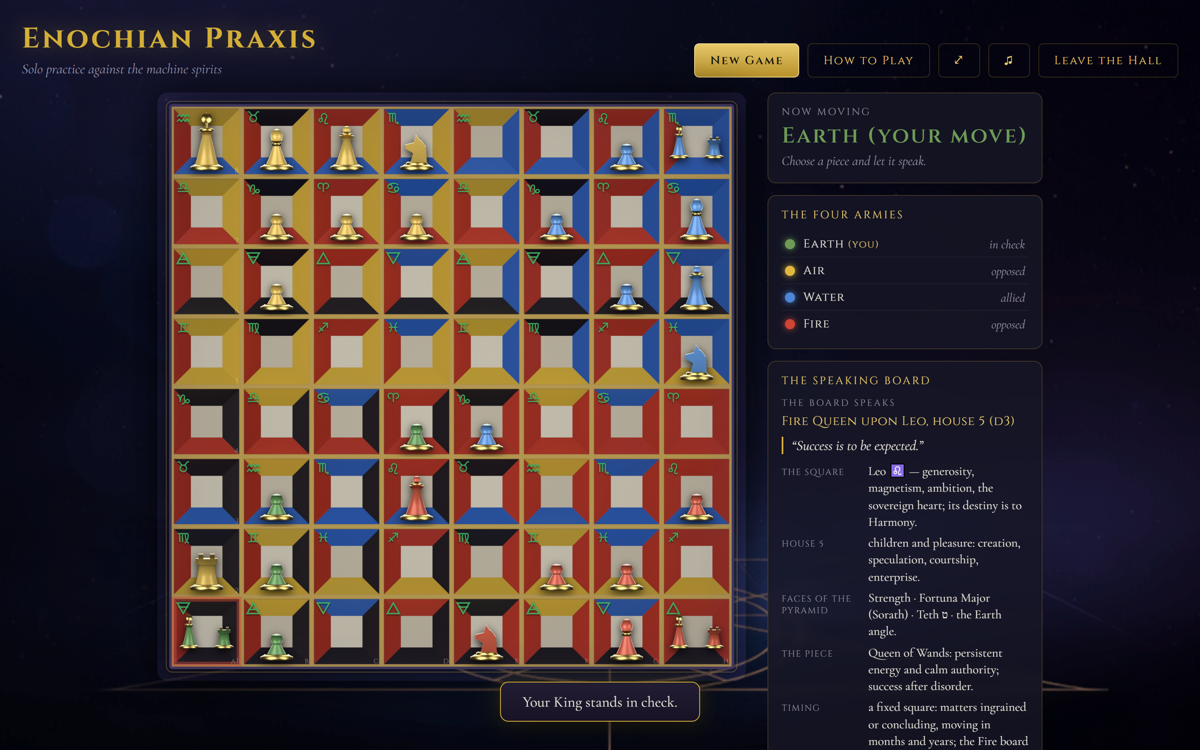
This is a different kind of divination from a spread. A tarot reading asks the cards to describe a situation. A game asks the elements to enact one and then leave their verdict on the board. Because the game takes real decisions, real risk, and real time, the reading it produces carries the weight of a story that happened rather than a picture that was shown. If you want the full method, the guide to divining with Enochian chess walks through how a finished game is turned into an answer.
The tarot is already on the board
Here is what makes the comparison closer than it looks. The Golden Dawn did not treat these as separate systems. The tarot is built into Enochian chess in two layers at once. First, the pieces are the court cards. Each army is one suit: Fire is Wands, Water is Cups, Air is Swords, Earth is Pentacles. Within an army the ranks map to the court, so the King stands for the Ace, the Queen for the Queen, the Bishop for the Prince, the Knight for the Knight, and the Rook for the Princess. Every capture on the board is a court card leaving the reading, and every survivor is a court card still in play. The full mapping is laid out on the page on the tarot trumps and its companion piece.
Second, the squares themselves carry attributions, and among those attributions is a tarot trump. Each square is drawn as a small pyramid seen from above, its faces bearing the symbols the Golden Dawn assigned to it. So when a piece lands on a square, a court card meets a trump, and the pairing means something. A whole game is a slow shuffle of the deck across a marked field, and the final position is a spread that the players dealt to themselves through play. That is why a chess reading and a tarot reading are not rivals so much as two speeds of the same practice. For the wider picture of how the two fit together, see Enochian chess and tarot.
What each does that the other cannot
A tarot spread does what a game cannot: it answers in minutes, alone, with nothing but a deck, and it can be repeated freely. It is the right tool for a quick question, a daily draw, or a reading on the move. Nothing in Enochian chess is that light. A game takes a partner or a patient hour running all four armies yourself, and it commits you to seeing the whole thing through.
What the board does that a spread cannot is let the symbols fight. A spread is decided the moment the cards land. A game is decided by choices, by which king you risk and which ally you save, and the reading is shaped by everything that happened on the way to the end. It is divination that you take part in rather than simply receive. For readers who want that fuller ritual, the divination page shows a worked example of a finished game read as an oracle.
Deal yourself a game
Play a full game of Enochian chess free in your browser, against the computer or with friends, and read the position it leaves behind. No download, no account for solo play.
Play NowKeep reading
Curious how a finished game becomes an answer? Read the divination guide, look at how the trumps sit on the squares, or step back to the broader link between the game and the deck.