Xiangqi, Chinese chess, and Enochian chess both start from the old idea of two armies facing each other, and then walk in opposite directions from it. Xiangqi keeps two sides but reshapes the terrain: pieces sit on the crossing points of the lines, a river splits the board across the middle, and each general stays locked inside a small palace he can never leave. Enochian chess keeps ordinary squares but multiplies the players: four elemental armies stand at the four corners, bound into two fixed alliances, and the whole board doubles as a divination instrument. Set beside each other, they show how much a game can change once you stop taking the familiar board for granted.
Two boards, two different maps
The Xiangqi board is a grid of lines, and the pieces rest on the intersections rather than inside the squares. That single choice reshapes everything, because a piece moves along the lines from point to point instead of across cells. Two features mark the terrain. A blank horizontal band called the river cuts the board in half, and some pieces change what they can do once they cross it, while others cannot cross at all. At each end sits the palace, a small square marked with diagonal lines, and the general and his guards are confined to it for the entire game.
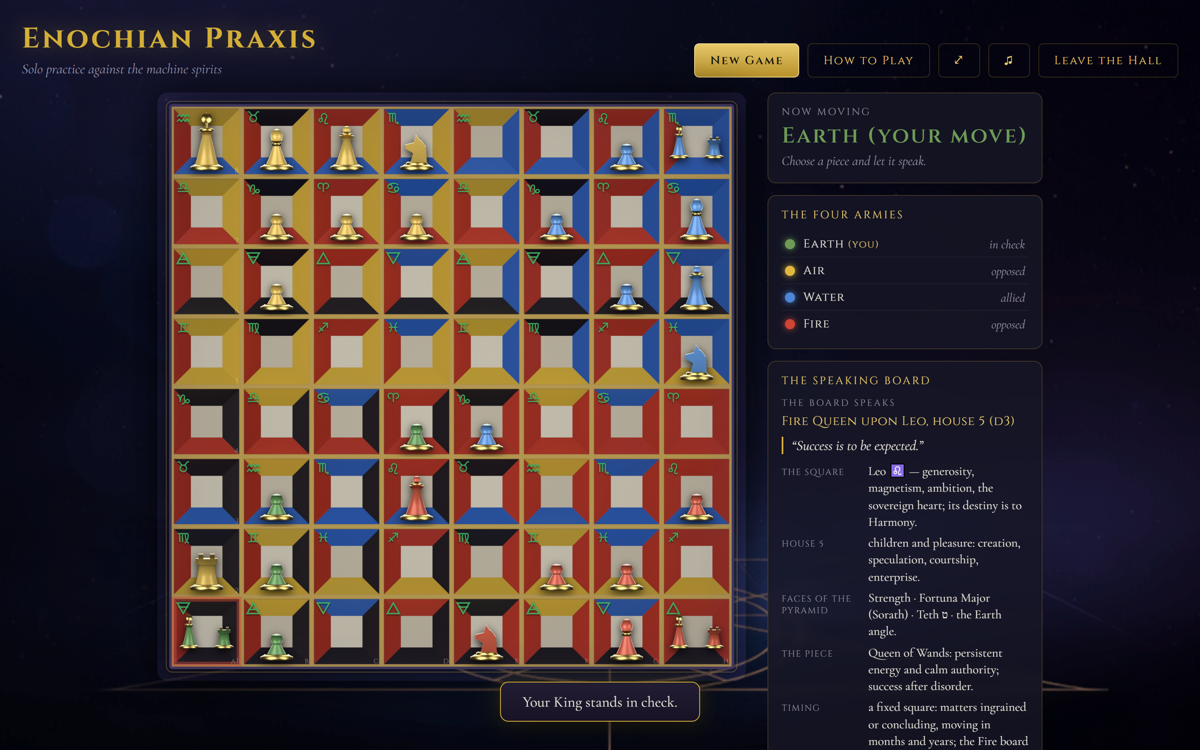
The Enochian board is closer to home at first glance. It is a standard eight by eight of alternating squares, and pieces stand on the squares the way they do in the chess most people know. There is no river and no palace. What replaces them is a division by corner. Four armies begin at the four corners, one to each, and the terrain itself belongs to an element. You can read more about that layout in the Enochian chess board explained, and about how the corners are shared out in the four elements of Enochian chess.
The king who cannot run, and the king who freezes
In Xiangqi the whole game bends around one rule: the general never leaves his palace. He shuffles between a handful of points behind his guards and his elephants, and the attack has to break in to reach him. Because he is penned, a Xiangqi endgame often turns into a careful siege of one small square of the board. There is also the famous flying general rule, where the two generals may not face each other down an open file with nothing between them, which quietly shapes how both sides arrange their defenses.
Enochian chess treats its kings in a way neither Xiangqi nor Western chess would recognize. There is no checkmate at all. A king is simply captured like any other piece, and the moment an enemy takes him, his whole army freezes. The frozen pieces stay on the board as inert terrain: they cannot move, they cannot be taken, they block sliding lines, and they threaten nothing. Stranger still, a frozen army can be woken again if a friendly king reaches its empty throne. If you want the full mechanism, see frozen armies, when a king falls. Two very different answers to the same question of what happens when the leader is cornered.
Two players against four armies
Xiangqi is a two-player game to its core. Red moves, black answers, and the entire contest is one line of attack meeting one line of defense. It shares that shape with the chess most players already know, even though the terrain and the pieces are wholly its own.
Enochian chess is not built for two sides. Four armies stand at the corners, and they are locked into two alliances that never change. Air and Fire play together as the active side; Water and Earth play together as the receptive side. Your ally sits at the corner diagonally opposite you, never beside you, so the two halves of a team attack from across the board rather than from one wing. Allies cannot capture each other and cannot check each other, and an alliance wins or loses as one. That does not mean you always need four people at the table. One player can run all four armies, and two players can each hold a whole alliance, as covered in can you play with two players. The alliance, not the single army, is the real unit of the game.
The pieces feel different in the hand
Xiangqi pieces carry their own logic. The cannon is the signature piece: it moves like a chariot along the lines, but to capture it must jump over exactly one other piece, friend or foe, using it as a screen. Elephants and guards are defensive and stay near home, and soldiers gain the ability to move sideways only once they have crossed the river. The result is a game that feels tense and positional, full of pinned lines and screens and a general who can never quite relax.
Enochian pieces mostly move in ways a chess player half recognizes, with one clear exception. The Knight, Bishop, and Rook behave much as their chess cousins do, jumping in an L, sliding along diagonals, sliding along ranks and files. The Queen is the surprise. She does not sweep the board; she leaps exactly two squares in any of the eight directions and jumps over whatever sits between, and she cannot move a single square at all. That makes her short range but hard to block, and it is the move newcomers misjudge most often. The Enochian chess queen explained walks through the leap in detail.
A board that plays, and a board that also reads
Xiangqi is a pure strategy game, and a deep one, with centuries of study behind its openings and endings. It does not claim to be anything else, and that focus is part of its strength.
The Enochian board carries a second layer that Xiangqi never sought. Every square holds a set of attributions, a sign of the zodiac, a tarot trump, a Hebrew letter, a geomantic figure, an astrological house, because the game came out of the Hermetic Order of the Golden Dawn as a study and divination instrument. The published Golden Dawn papers, most of which reached the public through Israel Regardie, set the game up so that a finished position can be read as an oracle. You are playing a real contest and, at the same time, laying out a pattern that means something. The divination page shows how a completed game is read.
Feel the difference for yourself
Reading how the Queen leaps and how an army freezes is one thing. Watching it happen on the board is faster. Start a free solo game and learn the flow in a few minutes.
Play NowKeep reading
Want the wider view? Begin with what Enochian chess is, learn the full rules, or see how it sits against the game most people already know in Enochian chess vs regular chess.