Occult chess is any use of the chessboard as a map of ideas rather than only a field for a contest. The board becomes a diagram, the pieces stand for forces, and the finished position can be read for meaning. Several traditions have treated chess this way in broad, symbolic terms, but one game built the whole idea into its rules from the first square: Enochian chess, the four-element game of the Hermetic Order of the Golden Dawn. This article walks through the wider family and then settles on the fullest example, which is the one you can play here.
Chess as a picture of the world
Chess has always invited allegory. The old ranks of king, counselor, and foot soldier looked to many writers like a picture of society, and moralists across the centuries used the game to talk about duty, fate, and the reach of small choices. That habit of reading a board for meaning is the seed of everything on this page. Once you accept that a piece can stand for something outside the game, you are one step from letting the whole position speak. Most symbolic chess stops at the level of metaphor: the board illustrates an idea, and no more is claimed. A smaller number of traditions took the next step and asked the board to answer questions.
The symbolic and divinatory strands
Two loose strands run through occult chess. The first is symbolic. Here the board and its pieces are matched to a system of correspondences: planets, virtues, elements, or the stages of some inner work. The game is a teaching device, a way to hold a large idea in a form you can turn over in your hands. The second strand is divinatory. Here the arrangement of the pieces, and above all the shape of a game once it has ended, is treated as a reading, the way a spread of cards or a cast of lots might be. These strands are not rivals. The strongest examples do both at once, because a board rich enough to teach is usually rich enough to read.
Kept in broad terms, that is the field. Boards have been matched to the heavens, to the elements, and to schemes of philosophy, and in a few cases the match was tight enough that players could treat a finished game as an oracle. What almost none of these efforts had was a complete, playable rule set that carried the symbolism all the way through. That is the gap the Golden Dawn's game fills, and it is why the rest of this page belongs to one board.
Enochian chess, the fullest example
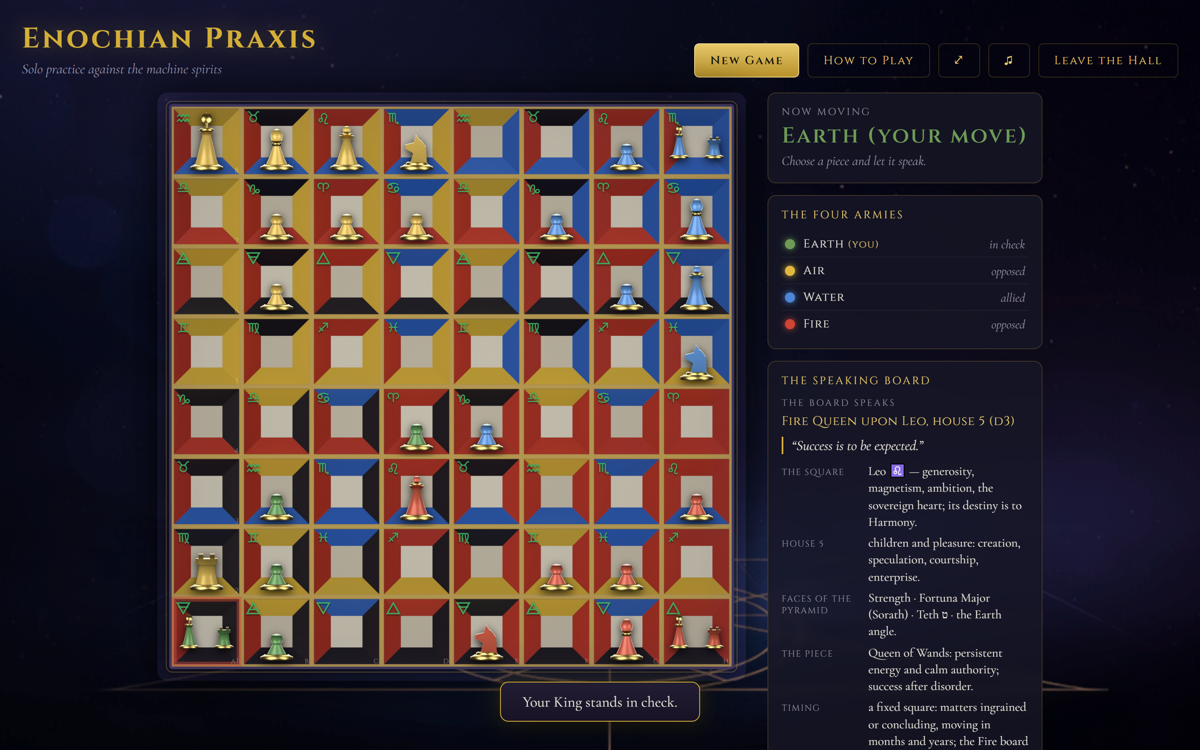
Enochian chess is where the symbolic and divinatory strands finally meet in a game you can actually sit down and play. It came out of the Hermetic Order of the Golden Dawn, the magical society of the late nineteenth century, where it served advanced members as both a study instrument and a divination tool. The name points at its foundations: the boards are built on the symbolism of the elemental tablets from the Enochian system recorded by John Dee and Edward Kelley in the 1580s. You can trace that thread in John Dee and the chessboard. The game reached the public mainly through Israel Regardie, who published the order's papers, and it is described in more detail on the history page.
What sets it apart is that the correspondences are not painted on afterward. They are in the structure. There is not one board but four, one each for Fire, Water, Air, and Earth, and a single game is played on whichever board you choose. Four armies sit at the corners, bound into two fixed alliances: Air and Fire on the active side, Water and Earth on the receptive side, with each army's partner at the corner diagonally opposite, never beside it. The rules themselves carry meaning. If you have only ever played ordinary chess, the differences are worth seeing side by side, and this comparison lays them out.
Where the reading lives
The divinatory layer sits underneath the whole board. Every square carries a set of attributions drawn from several systems at once: a sign of the zodiac, a tarot trump, a Hebrew letter, a geomantic figure, an astrological house. Each square is drawn as a small pyramid seen from above, its four faces bearing those attributions, so the board is a lattice of symbols before a single piece moves. Because of this, a finished game is not merely won or lost. The final position can be read as an oracle, the pieces having come to rest across a field of meaning. The worked method for reading a board lives on the divination page, and if you want to understand the elemental scaffolding first, start with the four elements.
This is the difference between a board that illustrates an idea and a board that answers with one. Symbolic chess in general stops at the picture. Enochian chess keeps the picture and adds the play, so the same act that decides a contest also produces the reading. It is the most complete surviving form of the family this article surveys, which is exactly why a site can be built around playing it rather than only writing about it.
A close relation worth naming
One thing can confuse newcomers reading around the subject. Enochian chess is sometimes called Rosicrucian chess, and both names appear in the literature. They are not two games. The two names come from two threads in the Golden Dawn's own symbolism, and they point at the same boards, the same armies, and the same rules. The full explanation, and why the split mostly survives as a search problem today, is in Rosicrucian chess: the other name. If you meet the game under one label in an old book and the other on a website, you are meeting the same board twice.
See it for yourself
The clearest way to understand occult chess is to play the game that carried the idea furthest. Start a free game in your browser, solo against the computer or online with others, and watch a real contest become a reading.
Play NowKeep reading
If the wider family drew you in but the elemental board is what you want to actually learn, the shortest path is the beginner's guide. From there the pieces, the boards, and the reading of a final position all open up, and each has its own page. Follow the links below to pick your entry point.