Enochian chess is decided by an alliance, not a single army. Two elements are bound together for the whole game: Air and Fire hold the active side, Water and Earth hold the receptive side. Your ally sits at the corner diagonally opposite you, never beside you, and the two of you win and lose as one unit. That single fact changes how every move should be judged. A move is good when it helps the pair, not just when it helps your own pieces. Playing well means feeding your partner's attack, guarding their King as if he were yours, and timing two forces so they land together from opposite ends of the board.
Play the alliance, not the army
The most common mistake is to treat your army like a lone side that happens to have a friend nearby. It is the reverse. The alliance is the real player, and your army is one of its two hands. You cannot capture your partner and you cannot give them check, so nothing you do threatens them and nothing they do threatens you. That frees both armies to press the same weakness rather than defend against each other. When you look at the board, do not ask what your Fire army can win this turn. Ask what the Air and Fire pair can win over the next several turns, and which of your pieces should set that up.
This is also why the game feels harder than ordinary chess at first, a point worth reading alongside how the two games differ. You are not tracking one plan; you are tracking two that have to agree. The reward is that a threat your own army cannot answer can often be met by your partner's army reaching across the board from the far corner.
Feeding your partner's attack
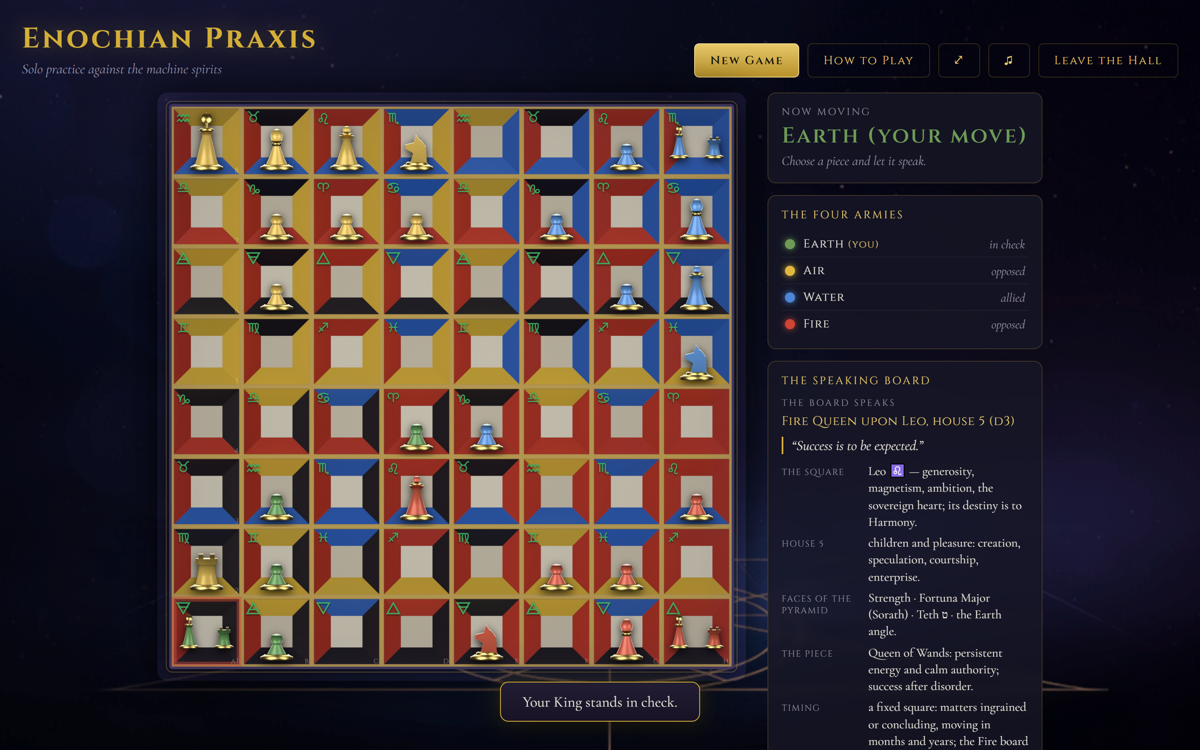
A single Enochian army is small: one King, four major pieces, and four pawns. Nine units rarely break a defended King alone. Two armies together can. The way to combine them is to let one army open a line and the other pour through it. Suppose your partner's pieces are already leaning on an enemy corner. Your job is not to start a second attack somewhere else; it is to add weight to theirs. Trade off the defenders they cannot reach. Clear a file or diagonal their Rook or Bishop wants to use. Put your own pieces where the enemy has to answer two threats at once and cannot answer both.
The Queen makes this concrete. She leaps exactly two squares in any direction and jumps whatever sits between, so she arrives on squares a slider could never reach and ignores the pieces in the way. That makes her a superb partner in a joint attack: she can drop onto a defended point the moment your ally's army pins the defender in place. If you want to understand how she supports a combined push, start with how the Queen actually moves. Read together, the two armies form threats that neither could make alone.
Covering your partner's King
An alliance loses the instant both of its Kings are taken, so a King in danger is the pair's problem, not one player's. There are two tools that only exist because you have an ally. The first is the rescue capture. When your partner's King stands in check, you may capture him yourself instead of letting the enemy do it. A King taken by his own ally is held in trust: his army does not freeze, and it keeps fighting under your command. That turns a lost King into a preserved force, but only if you are watching their corner as closely as your own.
The second is throne seizure. A King who reaches his ally's throne, the opposite corner, takes command of that army. If that army had frozen because its King was captured earlier, arriving on the throne wakes it back up. Both tools reward the same habit: keep one eye across the diagonal at all times. If your partner's King is exposed, a quiet defensive move of yours may be worth more than any attack, because losing either King brings the whole alliance one capture from defeat. For the fuller picture of what a captured King does to an army, see what happens when a King falls.
Timing two forces from opposite corners
Because allies sit diagonally opposite, your two armies advance toward each other and meet near the center. Turn order rotates around the board, so your two armies never move on the same turn; the play alternates between the two sides with every move. Coordination is therefore about tempo. You want your slower piece already in place when your partner's faster threat arrives, so the enemy faces both at once and has time to stop only one. Rushing one army forward while the other lags lets the defense meet each blow separately. The strongest attacks are the ones that mature on the same move, and that only happens if you count the turns between your pieces and theirs. This timing sense is the heart of good Enochian chess strategy.
Find a partner and play
Coordination is easier to feel than to read about. Claim a throne, invite an ally or let the computer hold the fourth seat, and play the pair as one mind.
Play NowKeep reading
If you are new to sharing the board, the sibling question is worth your time first: can you play with two players? It walks through how one person runs a whole alliance and how the same board scales from one seat to four.