The rescue capture is the move where a King who stands in check is captured by his own ally instead of by an enemy. When that happens the King is held in trust, and his army does not freeze. It keeps playing, now under the ally's hand. It is one of the strangest and most useful rules in the game, and it exists because Enochian chess has no checkmate. Kings are taken outright like any other piece, so the whole question of a King in check becomes a question of who captures him first, and to what end.
Why the rule exists
In ordinary chess the King can never be captured; the game ends the instant he is trapped. Enochian chess works the other way. There is no checkmate here, and a King can be taken like a Rook or a pawn. That single change creates a problem the Golden Dawn had to answer: what happens to an army when its King falls. The answer is severe. When an enemy captures a King, that whole army freezes and turns into inert terrain. Its pieces cannot move and cannot be taken, they block sliding lines, and they threaten nothing. A frozen army is scenery. For a fuller look at what that state does to a board, see frozen armies.
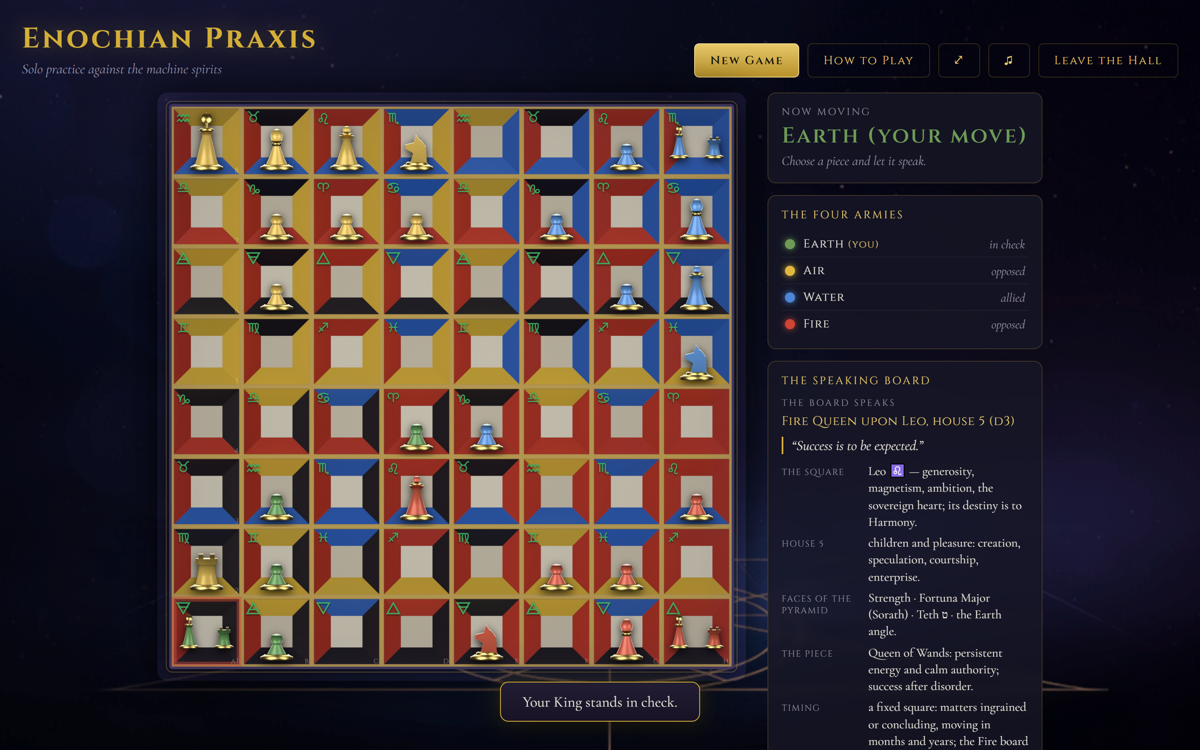
The rescue capture is the counter to that fate. If your ally's King is exposed and about to be seized by the enemy, you may reach him first. An ally who captures his partner's King does not destroy that army. He shelters it. The King is set aside, held in trust, and the army stays alive and mobile, fighting on under the ally's command. You have traded a King you were going to lose anyway for an army that keeps its full strength.
How it differs from losing a King to an enemy
The two captures look identical on the square: a King is removed. Everything after that is opposite. An enemy capture freezes the army into dead ground and moves the alliance one step toward defeat, because an alliance wins the moment both enemy Kings are taken. An ally capture keeps the army fluid and answers only to the partner. The same act, the removal of a King, either kills a force or preserves it depending on whose hand does it. That is the point of the rule. It gives the receptive and active sides a way to refuse the freeze.
Because your ally sits at the corner diagonally opposite you, never beside you, the rescue is a long reach across the board. It is not a piece you keep parked next to your partner's throne. It is a maneuver you set up, timing one of your armies so it can arrive on your ally's King in the moment before an enemy does. Allies never give check to each other and never capture each other under normal play, but the King in check is the single exception the rescue carves out.
When a rescue is even possible
A rescue capture can only happen while the King is in check. The published Golden Dawn papers set out a ladder of what a checked King must do, and the rescue lives inside that ladder rather than replacing it. If the King has a safe square, he must move to it. If he can move but has no safe square, he may move anyway or let another piece resolve the threat. If nothing at all helps, any lawful move stands and the King may fall. It is in that window, when the King is under threat and cannot simply walk to safety, that an ally reaching him becomes the better outcome than an enemy reaching him. The full sequence is laid out in our guide to check and the Golden Dawn ladder.
So the rescue is not a move you make idly. It only comes up when a King is already threatened, and it competes with the King's own options and with any piece that could block or capture the checking attacker. When those fail, or when they only delay the loss, taking your own King is the play that keeps the army standing.
How it changes defense
Once you know the rescue exists, defense in Enochian chess stops being about one army protecting one King. It becomes a shared duty across the alliance. A King under pressure is not necessarily a King you must save with his own pieces. He is a King one of two armies can answer for, and the ally often has the cleaner line. This is why coordination between partners matters so much, and why the game rewards players who think about both of their forces at once. If you play the two-army side of the game well, you are always watching whether your other army can reach a threatened throne in time. There is more on that partnership in playing as a team.
The rescue also feeds into the larger life-cycle of a King. An army held in trust is not gone for good. Command can shift again through throne seizure, when a King who reaches his ally's corner takes over that army, and a frozen force can be reawakened that way as well. A King captured by an enemy freezes his army; a King captured by an ally keeps it; a King who seizes a throne commands a second one. The rescue capture is one hinge in that whole machine, and it is the hinge that turns a certain loss into a continued fight.
See the rescue happen
Read about a move all you like; it lands differently when you watch a King change hands and the army keep marching. Start a free game and set up the reach yourself.
Play NowKeep reading
The rescue capture is easiest to grasp once you know what it is rescuing an army from and what happens to Kings in general. Learn what a frozen army becomes, read how the King lives and falls, and see how a game is actually won by taking both enemy Kings.