The Enochian Queen leaps exactly two squares in any of the eight directions and jumps clean over whatever sits between. That single fact, once you learn to exploit it, turns her into one of the sharpest attacking tools on the board. She does not sweep across long lines, so she will never trap a king from the far corner. What she does instead is arrive: she drops onto a square two steps away that no wall of pieces can defend against, and from there she forks, threatens, and sets traps that sliders cannot. If you only know how she moves, start with the rules explainer. This page is about putting the leap to work.
The fork nothing can block
The Queen's best trick is the double attack. Land her on a square from which two enemy pieces sit exactly two steps away, each on one of her eight lines, and you threaten both at once. Your opponent saves one and loses the other. This is an ordinary chess idea, but the Enochian Queen does it under conditions a chess queen never faces. Because she jumps, the pieces she forks do not need clear lines to her. They only need to sit at the right distance and direction. A defender who crowds the space between his pieces and your Queen has not defended anything; he has only given her cover to sit behind while she picks her targets.
The counting is what makes or breaks the fork. Both targets must be on the second square, never the first and never the third. New players reach for a fork where one victim is two squares off and the other is three, and the second escapes untouched. Before you commit her, trace each of the eight directions from her landing square and confirm the pieces you want sit precisely two away. When they do, the fork is as good as clean, because no blocker changes the outcome.
Threats across a crowd
A four-army game packs thirty-six pieces onto one board, and positions clog fast. That congestion is exactly where the Queen shines. A slider caught in traffic loses most of its threat; the Queen loses none. She reaches over your own front rank to strike an enemy piece behind it without spending a move to clear the way first, and she reaches over the enemy's shield to take the very piece it was meant to guard, since the shield is what she jumps.
Use this to break the illusion of safety. Your opponent parks a valuable piece behind a knot of pawns and thinks it settled. If it sits two squares from a spot your Queen can reach, it is not settled at all. The same congestion that would frustrate your Bishop or Rook is the Queen's working ground. She is a poor piece in wide-open space, where her two-square reach feels small, and a superb one in the scrum, where reach matters less than the ability to ignore obstacles. Plan her raids for the middlegame, when the board is at its most crowded, and hold her back from trades that only open lines for pieces she does not need help from.
Engineering a concourse
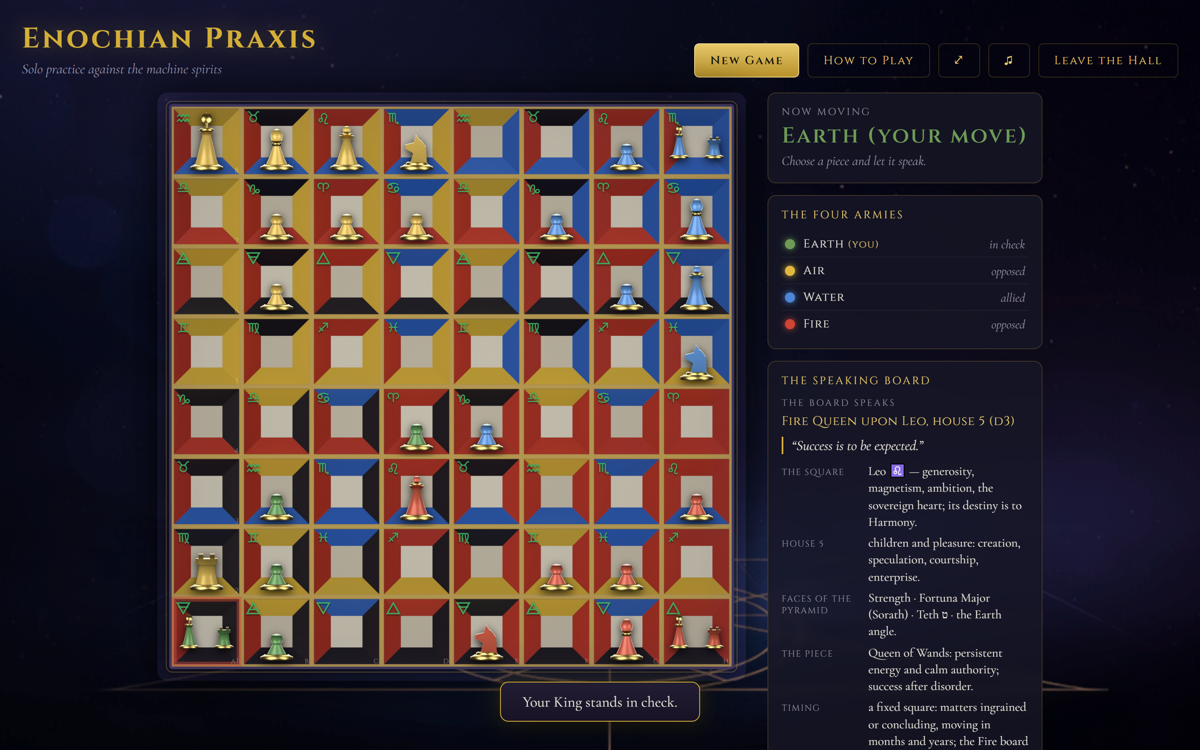
The Queen has one tactic no other line-piece shares: the concourse of the Queens. The published Golden Dawn papers mark five two-by-two blocks on the board, the central four squares and four near-corner blocks. If a Queen move leaves all four Queens, one from each army and none of them frozen, standing alone on the four squares of a single block, the Queen who just moved captures both enemy Queens outright and takes her ally's Queen under her guidance. It is a swing of three pieces in one move.
Because the block is only two squares wide and the Queen cannot move a single square, the meeting is always sealed by an arriving Queen leaping onto the empty fourth square, and that arriving Queen is the one who collects. So the tactic is not luck. You engineer it. You watch for three Queens already settled on three corners of a block, you make sure yours is the fourth to arrive and not one already sitting there, and you time the leap so no piece drifts onto the block and spoils the count. Setting the trap means nudging the position toward that shape over several moves, then springing it when your Queen is two squares from the open corner. The full mechanics, including the matching rule for the four Bishops, are laid out in the concourse rule.
Her color-bound path
Every tactic above runs into one hard limit: the Queen never changes color. A leap of two squares, in any direction, always lands her on a square the same shade as the one she left. Whatever color she starts the game on is the color she keeps until she is captured, exactly like the color-bound movement that constrains a bishop. Half the board is simply closed to her, and no sequence of moves opens it.
This shapes everything you plan with her. A fork only exists if both victims sit on her color. A concourse only forms on blocks where her color supplies the fourth square. An enemy piece parked one shade away is untouchable by your Queen no matter how the position shifts, so you must answer it with something else. The upside is that the limit cuts both ways: an enemy Queen can never reach the squares of her off color either, which gives you safe harbors to route your king and your softer pieces through. Learn which color your Queen owns in the opening array you are using, and read the board through that filter. Half the squares are hers to command and half are none of her concern, and the players who win with her are the ones who stop wishing otherwise.
Land the leap in a real game
Forks, crowd-jumping threats, and the concourse are easier felt than read. Start a free game and try the two-square leap against a live position.
Play NowKeep reading
Ready to fold the Queen into a full plan? Study the wider strategy of the game, learn how the elements pair into two alliances that decide who you can fork, and see the whole board that gives every leap its meaning in the board explained.