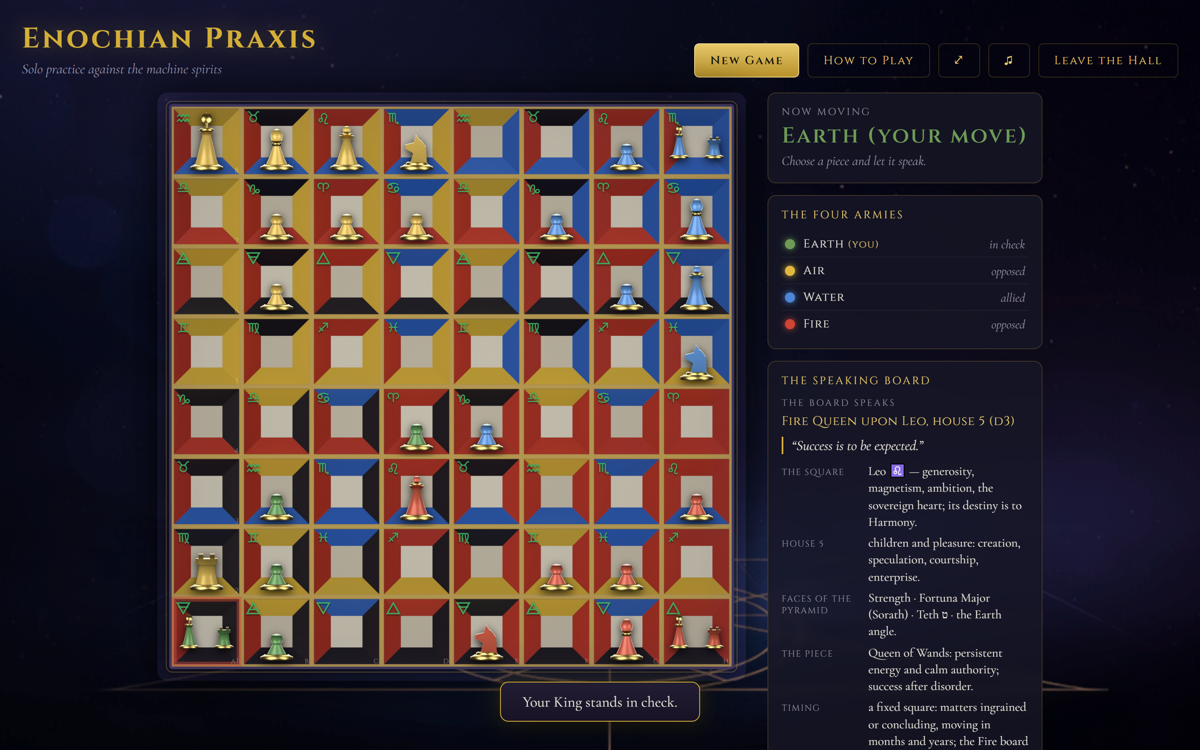
The Enochian Knight moves exactly the way a chess knight moves: the L-shape, two squares one way and one square across, landing over the heads of anything in between. Nothing about the step was rewritten. What changed is the board around it. Enochian chess packs four full armies onto a single eight-by-eight grid, thirty-six pieces where ordinary chess starts with thirty-two, and every one of them can block a line. On a board that crowded, the piece that refuses to be blocked stops being a curiosity and becomes one of your most reliable tools.
The one piece that ignores the crowd
Most of the army is a slider or a short leaper that cares deeply about what stands in its path. The Bishop and Rook slide until something stops them, and they are stopped by anything, including the frozen pieces of a captured army sitting on the board as dead terrain. Even the Queen, who leaps, only reaches two squares. The Knight is the exception. It jumps to its destination and does not care whether the intervening squares are empty, occupied by a friend, packed with enemies, or clogged with a frozen wreck. Where the other pieces get walled in by traffic, the Knight simply steps over the wall.
That freedom is worth the most in exactly the situations Enochian chess creates constantly. Four armies advancing from four corners jam the center early. Captured Kings freeze whole armies into place, turning quarters of the board into obstacles no slider can pass. In those tangles the Knight keeps its full mobility while everything else loses reach. If you are coming from ordinary chess and expect the Knight to be a minor piece, the four-cornered board quietly promotes it. You can read more about how these pieces differ from their familiar cousins in Enochian chess versus regular chess, and the full roster is laid out on the pieces page.
The Knight of its suit
Every piece in Enochian chess carries a tarot identity, and the Knight is exactly what its name promises: the Knight of its suit. The four elements map onto the four tarot suits, so the Fire Knight is the Knight of Wands, the Water Knight is the Knight of Cups, the Air Knight is the Knight of Swords, and the Earth Knight is the Knight of Pentacles. The court runs top to bottom across the whole army, with the King as the Ace, the Queen as the Queen, the Bishop as the Prince, and the Rook as the Princess, so the Knight sits as the mounted court card riding out ahead of the throne. This is the layer that lets a finished game be read like a spread. The connection between the pieces and the deck is covered in Enochian chess and tarot, and the elemental suits themselves in the four elements of Enochian chess.
Four god-forms, one for each army
The Golden Dawn dressed each piece in an Egyptian god-form, a different face for the same role in each of the four armies. The Knight wears four names. On the Earth board it is Horus. On the Air board it is Seb. On the Water board it is Sebek. On the Fire board it is Ra. These are attributions the published Golden Dawn papers assign to the piece, meant to be held in mind as the Knight moves rather than to change anything about how it plays. The whole scheme of divine faces across the armies is gathered in the Egyptian god-forms of the pieces. A Knight is still a Knight on every board; the name it answers to is what shifts from element to element.
The pawn that becomes a Knight
Every pawn in Enochian chess belongs to one of the four major pieces and stands in front of it at the start. One of those four pawns is the Knight's own. It marches toward the army's promotion edge, and when it gets there it does not turn into a Queen by default the way a chess pawn does. It becomes the piece it belongs to, which for the Knight's pawn means a new Knight. So the Knight is not only a piece already on the field but a destination a pawn is walking toward from the first move.
Two Enochian wrinkles make that promotion its own small drama. Promotion is delayed: a pawn that reaches the edge before its army has lost a single pawn stands waiting there and only turns into a Knight once the army suffers its first pawn loss. And if a pawn promotes while standing on a corner throne, it takes the piece that shared that throne at setup instead of the piece it usually belongs to, which can hand you a second Knight or deny you one depending on the array. The complete promotion picture, including the privileged final pawn, lives in pawns and promotion in Enochian chess.
Put a Knight to work
The fastest way to feel why the jumper matters is to watch the center jam and then leap over it yourself. Start a free game against the computer or claim a throne online.
Play NowKeep reading
The Knight is one of four majors, and each one reshapes on the crowded board in its own way. Meet its counterparts in the Queen, who leaps exactly two squares, and set the whole army in place with how the pieces move.