The Rook in Enochian chess moves exactly as the Rook you know from ordinary chess: any number of empty squares along a rank or a file, straight up, down, left, or right, never diagonally. It is a plain orthogonal slider, and it is blocked the moment it meets another piece, whether that piece is friend, enemy, or a frozen unit standing as inert terrain. No leap, no elemental twist to its motion. In a game where the Queen jumps and Kings can be captured outright, the Rook is the steady one, and that steadiness is exactly what makes it useful.
An ordinary slider on a strange board
Because the Rook behaves so normally, it is the easiest piece to reason about when you are learning the game. It commands the file it sits on and the rank it sits on, and it keeps commanding them until something stops it. That "something" includes frozen pieces, which is worth remembering: when an army loses its King, its pieces do not vanish, they stay put as terrain that blocks sliding lines. A Rook aimed down an open file can suddenly find that file walled off by a frozen unit that will never move again. If you have compared Enochian chess to the familiar game, the Rook is where the two overlap most cleanly, and it is a good anchor while the rest of the board teaches you its differences. For the wider picture of how each unit travels, see how the pieces move across the four boards.
What the Rook shares with its cousins the Knight and Bishop is that all three are the "major pieces" that flank the King, four of them per army alongside the Queen. The Bishop slides on the diagonals, the Rook slides on the straights, and between them they cover the board's two grains. On a corner-seated board where four armies advance from four directions, a Rook holding a central file or rank can reach across the whole width of play and answer a threat that began on the far side.
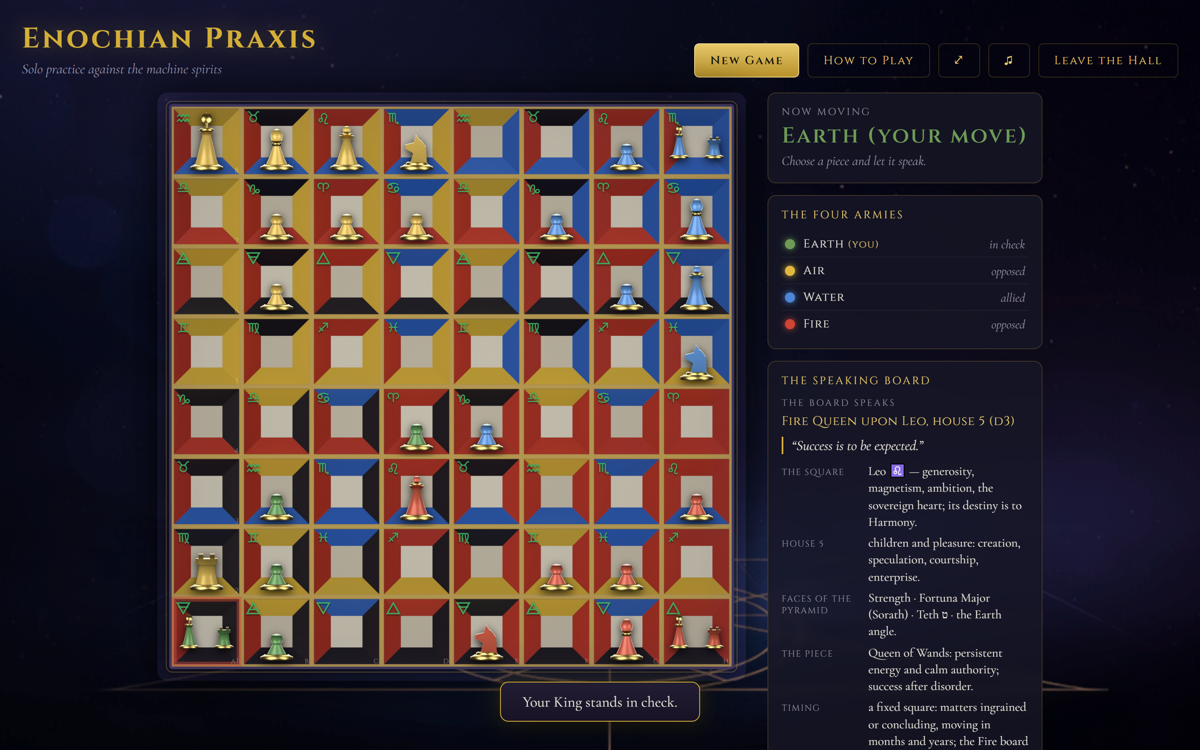
The Princess of the suit
Every piece in Enochian chess carries a tarot identity, and the Rook is the Princess of its element's suit. The King is the Ace, the Queen keeps her own name, the Bishop is the Prince, the Knight is the Knight, and the Rook is the Princess. Suit follows the board's element: Wands for Fire, Cups for Water, Swords for Air, Pentacles for Earth. So a Fire Rook is the Princess of Wands, a Water Rook the Princess of Cups, an Air Rook the Princess of Swords, an Earth Rook the Princess of Pentacles. The Princesses are the youngest, most earthed figures of the tarot court, the part of each element that touches the ground, which sits well on the piece that plods in straight lines rather than leaping or riding. If the whole court mapping interests you, the connection between the game and the cards is its own study; the same layer feeds the reading a finished game becomes.
A pawn that becomes the throne partner
The Rook has one quiet path to greater things. Each Enochian army begins with its King doubled on the corner throne beside a single major piece, the throne partner chosen by the game's setting. In some settings that partner is the Rook. That matters for promotion, because a pawn does not always become the piece it belongs to. The ordinary rule is that a pawn promotes to its owner, so the Rook's pawn would become a Rook. But a pawn that promotes on a corner square becomes whatever piece shared the King's throne in that setting. When the setting seated the Rook as throne partner, a pawn crowning on the corner rises as a Rook, taking the seat of the piece that opened beside the King. The corner, the throne, and the Rook line up, and a foot soldier ends the game as a slider guarding the very square its King began on. Promotion in this game has other wrinkles too, including a delay tied to losing a pawn first.
The god-forms of the Rook
The published Golden Dawn papers dress each piece in an Egyptian god-form, and the four Rooks carry the god-forms Nephthys, Tharpeshest, Shooen, and Anouke. The Earth Rook is Nephthys. The Air Rook is Tharpeshest. The Water Rook is Shooen. The Fire Rook is Anouke. These are attributions laid on the piece for meditation and for reading the board, not extra rules; the Rook still just slides. But they give the humblest slider a face, and they tie it into the larger scheme where every square, every piece, and every move can be spoken as symbol. The full roster of god-forms across all the pieces is worth seeing together, because the pattern only shows itself at the level of the whole army.
Its job: hold the lines
In play the Rook does the unglamorous work. It holds files and ranks, it backs up advancing pawns, and it waits behind the front while flashier pieces trade. Its value climbs as the board empties, when open lines appear and there is finally room to slide the full width of the board. Early on it can feel stuck, hemmed in by its own pawns and by the crowd of thirty-six units the game opens with. Patience is the Rook's virtue. Keep it safe, clear a file, and let it reach. When you are weighing which pieces to trade and which to shelter, the Rook usually wants to be the last piece standing on an open board rather than the first one spent. That instinct is part of sound Enochian strategy, and it comes straight from how the piece moves.
Put a Rook on an open file
The fastest way to feel what the Rook does is to slide one down a cleared line and watch the board narrow around it. Start a free game and try it.
Play NowKeep reading
The Rook makes most sense next to the piece it is not. Meet the leaping Queen to see the game's one truly strange mover, then read how the Rook, Knight, and Bishop split the work between them among the three flanking pieces.