The word "Enochian" in Enochian chess is the name of a language. In the 1580s, John Dee and Edward Kelley recorded what they described as an angelic tongue, complete with its own alphabet and its own texts, and that recorded language is the reason the game is called what it is. There is no chess in the language and no language on the board, yet the name travels straight from one to the other. It travels because the Golden Dawn, building its four-cornered chess three centuries later, drew the elements of the board from the very system that produced the Enochian tongue. Name and symbolism came from the same source.
What Dee and Kelley recorded
John Dee was a mathematician and an adviser to Elizabeth I, one of the more learned men of his age, with a scholar's habit of writing everything down. Edward Kelley worked beside him as the scryer, the one who gazed into a crystal and spoke aloud what he claimed to receive. Across a long run of sessions in the 1580s, the two conducted what their records call angelic workings. The most striking product was a language: a set of letters, words, and passages that Dee took down as though from dictation, together with a script for writing them. Later occultists gave the whole body of material a single name, the system of Enochian magic, and the language sits at its center.
For Dee this was not a game or a curiosity. It was religious and intellectual work of the most serious kind, and his manuscripts hold prayers, received names, and the language itself, all treated with care. Nothing in them is meant to be played. There is no board, no piece, no rule of movement anywhere in what he left. The connection to chess would come from other hands entirely, long after Dee and Kelley were gone.
How a language became a game's name
The Hermetic Order of the Golden Dawn was a magical society of the late nineteenth century, and it treated Dee and Kelley's records as raw material to build on. The Enochian workings stood among the order's most advanced teachings, studied only by members who had come a long way. When the order wanted a study and divination instrument for those members, it made a chess: four elemental boards, one each for Fire, Water, Air, and Earth, with four armies fighting from the corners in two fixed alliances. Because the whole apparatus was drawn from the Enochian system, the game inherited the name of that system's language. That is the honest chain. Enochian names the source, not the moves.
Which means the name tells you about the game's ancestry rather than its rules. The pieces themselves are Victorian inventions: the King who begins doubled on his throne beside a partner piece, the Queen who leaps exactly two squares and can never move one, the freezing of an entire army when an enemy captures its King. You can learn how each of those works without touching a single Elizabethan manuscript, starting with what Enochian chess is and then the full rules. But the shell around those rules, the four elements and everything hung on them, comes straight from Dee.
The elements come from the same system
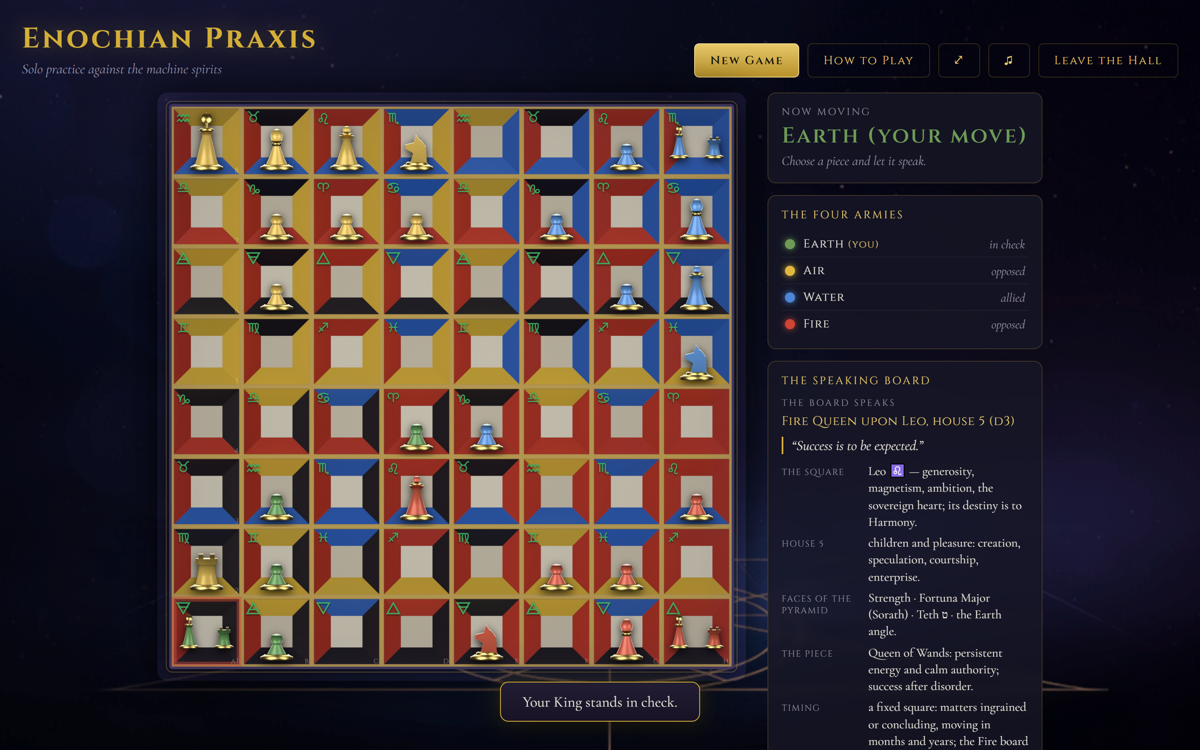
The Enochian material Dee recorded was not only a language. It also carried a strong fourfold structure, four elemental divisions that the Golden Dawn read as a working map of Fire, Water, Air, and Earth. That structure is what the board makes visible. Each element owns one board and one corner: Earth sits at a1, Air at a8, Water at h8, Fire at h1. The four armies are not free agents either. They are locked into two alliances, Earth with Water on the receptive side and Air with Fire on the active side, and your ally always holds the corner diagonally opposite yours, never the one beside you. If the pairing scheme is new, the four elements of Enochian chess lays out how the two sides fit together.
The element even decides who begins. On the Fire board, the Fire army opens; each board leans toward its own element from the first move. This is the point where the language and the game touch most clearly. The order did not invent a set of four colors and call them elements. It took the elemental logic already present in the Enochian system and gave it a shape you could move across. The name and the fourfold board are two branches of one root.
The symbolism runs deeper than the corners
The elements are only the top layer. Every square on an Enochian board carries its own attributions drawn from the wider Golden Dawn scheme: a sign of the zodiac, a tarot trump, a Hebrew letter, a geomantic figure, an astrological house. Each square is drawn as a small pyramid seen from above, its four faces bearing symbols, so the whole board reads as a field of correspondences rather than a plain grid. Those layers are why a finished game can be read as an oracle instead of merely scored. The divination page walks through a worked example, and the board explained takes apart the anatomy of a single square.
None of these layers appear as such in Dee's manuscripts. He recorded a language and an elemental structure; the tarot trumps, the Hebrew letters, and the rest are the order's own overlays, added by a Victorian mind reading a Renaissance source. That is worth holding onto. Enochian chess is a Golden Dawn creation that borrowed a name and a fourfold skeleton from Dee, then clothed both in three centuries of later correspondence. The name is accurate about the borrowing and silent about the invention, which is exactly how borrowed names usually work.
Where the record comes from
Most of what the public knows about the game, its rules and its symbolism alike, reached print through Israel Regardie, who published the order's papers. The published Golden Dawn papers are the source, and they are consistent on the lineage: a language and an elemental system recorded by Dee and Kelley, taken up and turned into a game by the order. The same game also goes by a second name, Rosicrucian chess, after the Rosicrucian framing the order used for its inner work. Both names point at one set of rules; you can read why the second one exists in Rosicrucian chess, the other name.
So the name earns its keep the way a place-name earns its keep after the people who coined it are gone. When you slide a Fire army toward the far edge of the board, you are moving pieces across a Victorian reading of an Elizabethan record, one whose vocabulary was set down as a received language more than four centuries ago. The moves are new. The elements they move through are old, and the word stamped across the whole thing points back to the tongue that started it.
See the elements in motion
The quickest way to feel where the name comes from is to open a board and play the elements against one another. Start a free game against the computer, or claim a throne online.
Play NowKeep reading
Want the rest of the lineage? Read about John Dee and the chessboard, meet Edward Kelley and the scried tablets, or step back to the history of how the order built the game.