The Fire army sits at the h1 corner of the board, and the published Golden Dawn papers dress its five pieces in Egyptian god-forms: King Chnupis Kneph, Knight Ra, Queen Sati-Ashtoreth, Bishop Toum, and Rook Anouke. These are attributions, one name laid over each piece, not extra rules. A Fire Queen still leaps her two squares whether you call her the Queen or Sati-Ashtoreth. But the names are the point of the layer. They tell you which powers the Golden Dawn read into the Fire corner, and they make the army something you can picture rather than just push.
Every army carries a set like this. The four elemental corners each take five god-forms, one for the King and one for each of the four majors, drawn from the same Egyptian pantheon the order worked with across its curriculum. If you want the whole grid at once, the Egyptian god-forms of the pieces lays out all four armies together. This page stays with Fire.
King Chnupis Kneph, the throned Fire
The King is Chnupis Kneph. That double name is one of the obscure renderings the papers are full of: a Greek and transliterated form of an old creator idea, the breath or spirit that shapes matter, often drawn as a ram-headed figure. Do not expect it to match the spelling in a modern dictionary of Egyptian religion, because it will not. The order took its names from Victorian sources and its own working, and the result is a private vocabulary. What matters for the board is the role. This is the still center of the Fire corner, the piece the whole army is built to protect, doubled on its throne at the start of the game beside one major partner. When you read about the King in Enochian chess, Chnupis Kneph is the Fire face of that piece.
Knight Ra, the sun
The Knight is Ra, and here the papers reach for a name everyone knows. Ra is the sun god, the daylight power at the head of the Egyptian pantheon, and it is easy to see why a solar figure lands on the Fire army. The Knight is the leaping piece, the one that jumps its L-shape over whatever stands between, and giving it the sun suits a corner that is meant to read as heat and light. That is as far as the plain facts go: Ra is well known, the attribution is simple, and there is no need to invent a myth to explain it. The Fire Knight moves like any Enochian knight, described alongside its cousins in the knight, bishop, and rook.
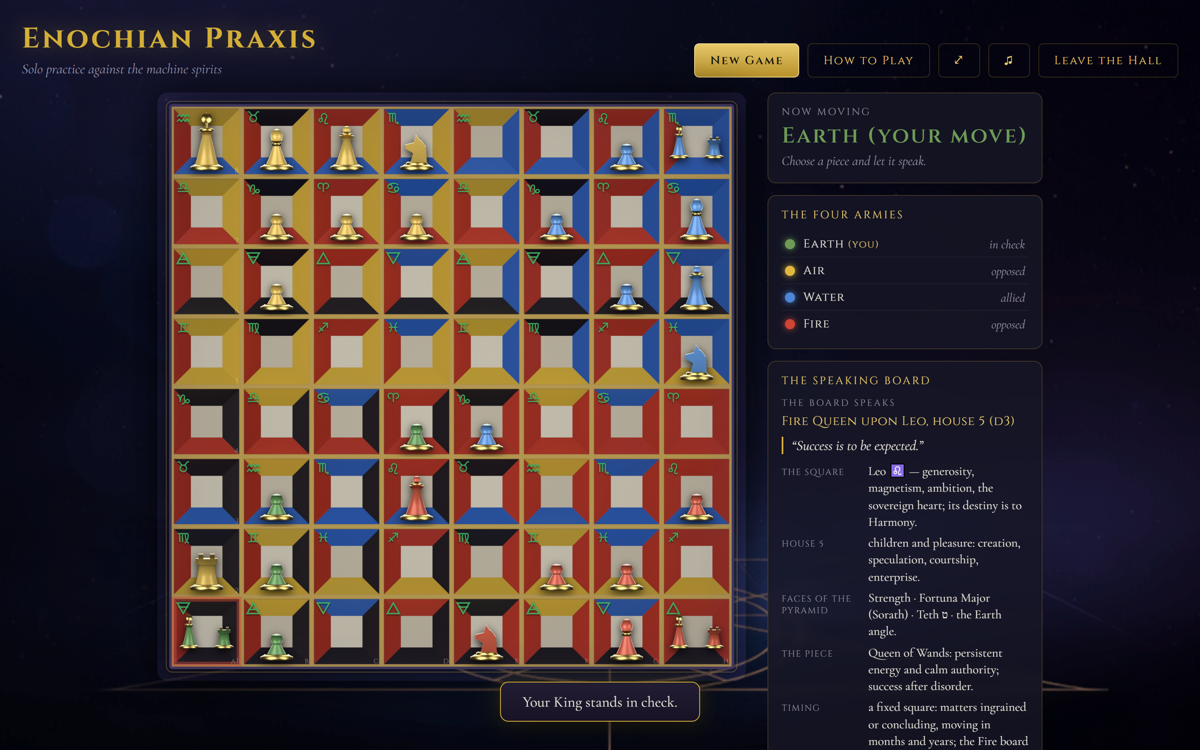
Queen Sati-Ashtoreth, the paired goddess
The Queen is Sati-Ashtoreth, another compound the papers hand over without much comment. It joins an Egyptian name with Ashtoreth, a goddess-name that traveled widely through the ancient Near East, and the pairing is exactly the kind of blended rendering that marks this system. Call it what it is: an obscure attribution, not a figure with a fixed story you should try to fill in. On the board she is the Fire Queen, the strange leaping piece that jumps to a square exactly two away and never moves just one. If you want to see how differently she behaves from the chess queen you know, the Enochian chess Queen has the full account of the leap.
Bishop Toum, the closing power
The Bishop is Toum, a rendering of the god more usually written as Atum, the completing or setting form associated with the close of the day. In the four-piece grammar of an Enochian army the Bishop is the diagonal slider, the long-range piece that runs until something blocks it. Toum gives the Fire corner a second solar note beside Ra, but a very different one: not the sun climbing but the sun finishing its arc. That is the whole attribution. As with the other names, the papers offer the god-form and leave you to sit with it rather than spelling out a legend.
Rook Anouke, the guarding form
The Rook is Anouke, a form of the goddess more often written Anuket, tied in Egyptian religion to the river and its flood. On the Fire board she is the Rook, the orthogonal slider that holds ranks and files and, in the Golden Dawn court mapping, stands as the Princess of the suit. Every square of every board is drawn as a small pyramid seen from above, and the pieces move across that landscape of pyramids while carrying these god-names, which is a large part of why the game was treated as a meditative instrument and not only a contest.
Why the names are dressed this way
The god-forms are not decoration bolted on after the fact. Fire is Wands in the tarot court that the order laid over the pieces, and the five pieces map to court cards: the King to an Ace, the Queen to the Queen, the Bishop to a Prince, the Knight to a Knight, and the Rook to a Princess. The Egyptian names sit on top of that same structure, so a single Fire piece can be read as a rank, a tarot court card, and a god-form all at once. That stacking is the reason a finished game could be read as an oracle. The Fire board that carries all of this has its own page in the Fire board, and the divinatory layer as a whole is worked through on the site's divination pages. The god-forms are one thread in that weave, the one that gives each army a face.
A caution worth keeping: these names are attributions from a specific Victorian magical order, not a clean lesson in Egyptian mythology. Some, like Ra, are familiar. Others, like Chnupis Kneph and Sati-Ashtoreth, are compound and obscure renderings that will not line up neatly with any modern reference. Take them as the Golden Dawn meant them, as symbolic dress for the five Fire pieces, and let the plain fact of the assignment stand without embroidery.
Meet the Fire army in play
Start a free game on the Fire board and watch Chnupis Kneph, Ra, Sati-Ashtoreth, Toum, and Anouke take their corner. Play solo against the computer or bring others online.
Play NowKeep reading
Once the Fire corner makes sense, follow the same idea across the board. See the full set of Egyptian god-forms, learn what the Fire corner sits on in the Fire board, or step back to how the whole set of pieces is put together.