Guard your King above every other consideration, because the moment an enemy captures him your entire army freezes on the spot. Enochian chess has no checkmate and no warning bell. Kings are taken outright, the same as a pawn or a Rook, and a captured King leaves a field of statues that cannot move, cannot be captured, and threaten nothing. If you learn one defensive habit, make it this: count the squares an opponent can reach around your throne before anything else. The King is not a piece you protect on the side. He is the piece that keeps your side breathing.
Why the King is the whole army
In ordinary chess a lost King ends the game and nothing more. Here the loss is heavier and stranger. When an enemy takes your King, your army does not surrender or vanish. It freezes exactly where it stood. Those frozen pieces still occupy their squares and still block the sliding lines of enemy Rooks and Bishops, but they will never move again, and no one can capture them either. A living force becomes terrain in a single move. That is why defense carries more weight in this game than in any version of chess you have played, and why the full behavior of a fallen force is worth reading on its own in Frozen Armies: When a King Falls. For a wider picture of how a King is captured, held, and rescued, the piece has its own study in the King in Enochian chess.
Because there is no mate, an alliance wins only when both enemy Kings are off the board. So every defensive decision is really a question about that finish line. Keep both of your Kings breathing and the enemy cannot win, no matter how much material they pile up. Lose one carelessly and you have handed half your fighting force away as scenery.
Reading threats around the throne
The King steps one square in any direction and captures the same way, which makes him slow and short of reach. He cannot outrun a threat; he can only sidestep it. So defense begins with sight, not motion. On your turn, look at every enemy piece that could reach your King's square or the squares next to it. Watch the Queen most closely. She leaps exactly two squares and jumps over whatever sits between, so she ignores the wall of bodies you might have counted on to shield the throne. A blockade that would stop a Rook does nothing against her. If you are unsure how each attacker travels, keep the movement rules handy while you read the board.
Two mercies sit quietly in your favor, and both are easy to forget under pressure. Your allies never give check to you, so a partner's Queen bearing down on your King is no danger at all. And frozen pieces threaten nothing: a fallen enemy army's Queen may stare straight down a line at your throne and mean nothing by it. Ignoring harmless attackers is as much a part of defense as spotting the real ones. The corners never sit side by side, either. Your ally holds the corner diagonally opposite yours, so aid arrives across the long diagonal, not from the square next door.
The check ladder and keeping escape squares
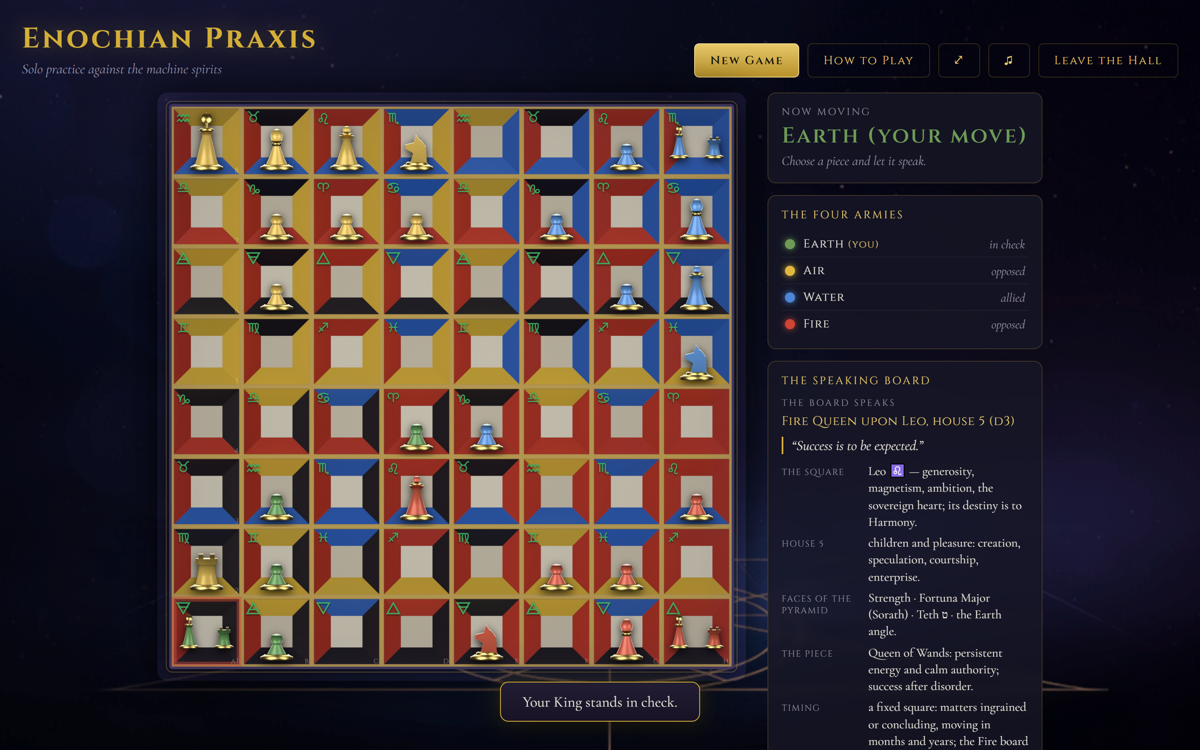
Check still exists, and the published Golden Dawn papers set it out as a ladder of duties. If your checked King has a safe square, he is required to move to it. If he can move but every square is unsafe, he may step anyway or another piece may block or capture the attacker. If he cannot move at all, some other piece must resolve the check when one can. Only when nothing helps does the King simply fall. The practical lesson runs backward from that ladder: your defense is strongest when the top rung is always available, which means keeping at least one genuinely safe square beside the King. A throne boxed in by its own pieces is a throne one leap from disaster.
So leave your King room to breathe. Do not crowd all four of his neighbors with your own pieces, because a King with no empty square depends entirely on a blocker arriving in time. Watch the diagonals as carefully as the ranks and files, since the Queen's two-square jump and the Bishop's long slide both come in on the slant. Whole tactical patterns turn on this, and more are worked through in the general strategy guide. The short version is easy to hold in your head: safe square first, blocker second, prayer last.
Spending the rescue capture
The game gives you one defensive tool that has no equal in ordinary chess. When your King stands in check, your own ally is allowed to capture him. It sounds like betrayal and it is the opposite. A King taken by an enemy freezes his army; a King taken by his partner is simply held in trust, and his army keeps every move it had and fights on under the ally's command. No enemy claimed him, so the freeze never comes. You have spent the King's presence on the board to buy his soldiers their continued life.
Time this well and it saves a game. When the check ladder has run out and the enemy will take your King next turn no matter what, let your ally take him first. The whole army stays in motion instead of turning to statuary, and an army that can still move can still help win the field. This is the deepest reason the two allied Kings should never wander too far apart: a partner too distant to reach the checked King cannot perform the rescue. The move earns a full walkthrough in the rescue capture, and it is worth practicing until it feels natural rather than desperate.
Why the doubled start matters
Every army begins with its King doubled on the throne, sharing that single corner square with one major piece, the throne partner named by the opening array. Two units stand on one square until one steps off. That doubled start is a defensive gift, and new players squander it constantly. The partner is a bodyguard already in position, and while both units share the throne the corner is dense and awkward for an attacker to pick apart. Move the King off too early, out into the open board where his one-square crawl leaves him exposed, and you throw away the safest square he will ever hold.
The patient approach is to develop your other pieces first and let the King sit behind his partner while the board is still crowded and dangerous. Keep him home until you have a clear reason to walk him, and when you do, know where he is going. A King who marches toward his ally's throne can seize command of that army and even wake it if it has frozen, which turns his slow crawl from a liability into the largest swing the game offers. A King who simply wanders forward is a King begging to be taken. If you are still finding your footing, the beginner's guide lays out a first-game plan that keeps the throne safe by default.
Guard a throne yourself
Defense makes sense fastest on a live board. Start a free game against the computer and see how long you can keep both of your alliance's Kings standing.
Play NowKeep reading
Once your Kings are safe, the same care wins games. See exactly how a game is won, learn the full rules of play, or start with what Enochian chess is.