Sagittarius belongs to the Fire army. The Enochian board is built on the four elements, and every sign of the zodiac is sorted onto it by its element, so the mutable Fire sign answers to the same force that drives the Fire board and the Fire pieces. That is the whole answer at the level the game works on. The board does not pin Sagittarius to a single square you can point at, and neither will this page. What it does is give the Archer a home among the four armies, and once you know which home, the sign's reach and its aim start to read like moves.
Why Sagittarius is a Fire sign here
The zodiac carries three signs of each element, and Fire holds Aries, Leo, and Sagittarius. Aries is the cardinal spark that starts the fire, Leo is the fixed heat that holds it, and Sagittarius is the mutable flame that carries it outward and hands it on. All three sit with the Fire army. The Golden Dawn built its whole system of correspondences on these element ties, and the board inherits them directly. When you learn how the four elements organize the game, you are also learning how the twelve signs find their seats. Sagittarius does not get a special exception. It is Fire, so it rides with Fire.
Mutable does not mean weak. It means adaptable, the quality of a season turning into the next one. Sagittarius is the fire that has stopped needing to prove itself and starts to travel. That restless, forward-leaning temperament is exactly the note the Fire army strikes on the board, and it is why the Archer reads so naturally against this element rather than any other.
Reach and aim, read on the board
Sagittarius is the archer who sights a far target and looses. Reach and aim are its two words. Both have a plain counterpart in how the Fire army fights. Fire belongs to the active alliance, paired with Air, and the active side is the one that presses forward and forces the question. An army that wants distance and a clear line is an army that thinks the way the Archer thinks: pick the far mark, commit to the shot, do not shorten the draw at the last moment.
Two pieces make the point without any invention. The Bishop and the Rook are the long lines of every army, the sliders that run the full length of an open file or diagonal until something stops them. That is reach in its literal form: a piece that answers a threat from across the board. You can read more about the knight, bishop, and rook and how their ranges differ. The Queen is the other side of the coin. She does not slide at all. She leaps exactly two squares in any direction, jumping over whatever stands between, which makes her a short-range specialist who strikes past cover rather than through open space. Reach and aim are not the same tool, and the Fire army carries both. Sagittarius, the sign that both surveys the whole horizon and fixes on one point of it, sits comfortably over that pair.
The sign lives in the layer, not on a square
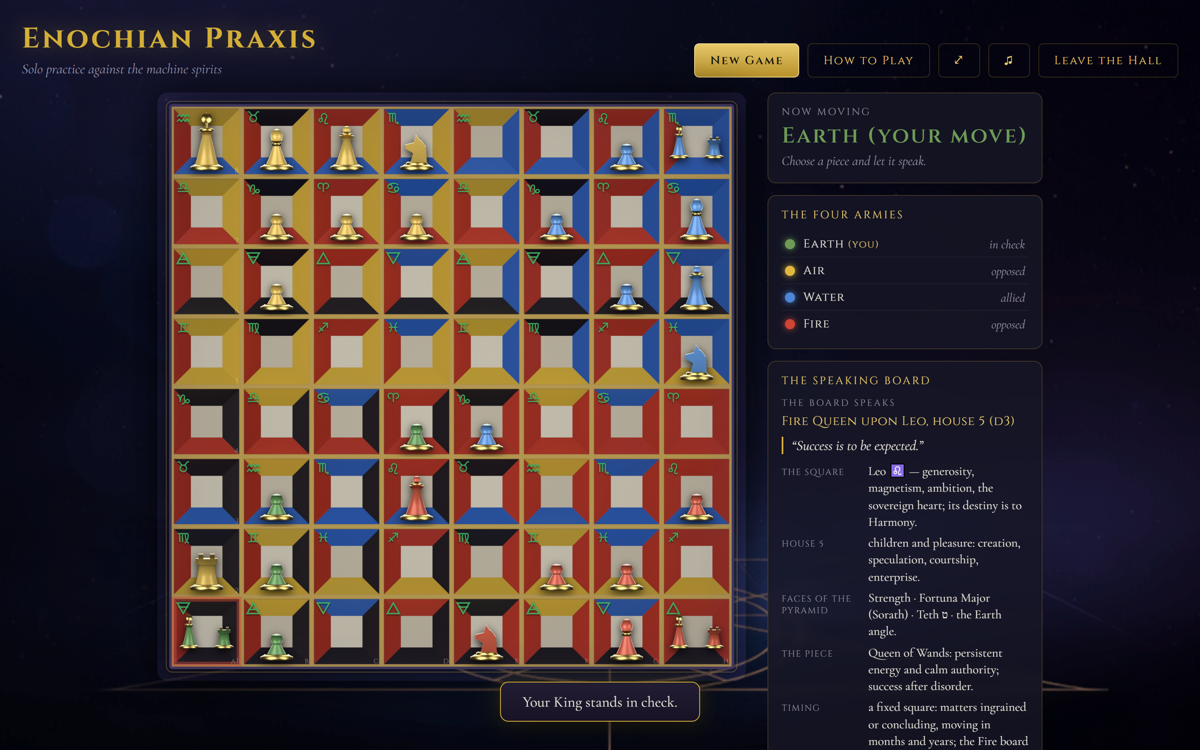
It is worth being exact about where Sagittarius actually appears in the game. Every square of the board carries a stack of divinatory attributions: a sign of the zodiac, a tarot trump, a Hebrew letter, a geomantic figure, an astrological house. Each square is drawn as a small pyramid seen from above, its four faces bearing those marks. The signs are woven through that layer, not stamped on one cell like a label. So Sagittarius is present the way an element is present, distributed through the symbolic fabric of the board rather than parked on a home square you could name. This is the honest reason a good zodiac page speaks at the system level and stops there. To go further and hand you a specific square would be to invent a rule the game does not hold. If you want to see the whole scheme, the zodiac on the board lays out how all twelve signs are threaded through the attributions.
Playing on the Fire side
When you sit with the Fire army, you are holding the force that Sagittarius answers to. On the Fire board the Fire army opens, since the board's own element moves first, so the active temperament gets the initiative from the very first turn. That suits a sign whose instinct is to loose the arrow before the target moves. Fire also does not fight alone. It is bound to Air in a fixed alliance, and the two armies win and lose together, their partner sitting at the corner diagonally opposite rather than beside them. The Archer's habit of aiming far across a gap is a small echo of that: the ally you coordinate with is the one furthest from you on the board, and the game constantly asks you to think across that distance.
None of this changes how the pieces move or how a game is won. It is a lens, the same lens the Golden Dawn used, laid over a game that stands on its own as chess. The published Golden Dawn papers, which reached the public mainly through Israel Regardie, set every square inside a system of elemental correspondences, and the zodiac is one thread of that system. Sagittarius is the mutable Fire thread, and it belongs to the army that presses the horizon.
Take the Fire side
Play a free game on the Fire board and hold the army the Archer answers to. Feel how the active side takes the initiative and drives the far line.
Play NowKeep reading
See the army up close on the Fire board, then step back to the astrology inside the board to see how the signs, houses, and elements sit together in one scheme.