Taurus is the fixed sign of the Earth element, and on the Enochian board the Earth element belongs to one of the four armies. That is the tie. The board never puts Taurus on a single square as a label you can point to; instead the sign works at the level of its element, coloring the Earth army and, through it, the receptive alliance that Earth shares with Water. When you understand Taurus as steadiness that does not want to move, you understand a great deal about how the Earth force behaves and about how it reads once a game is over.
Fixed Earth, and where Earth sits
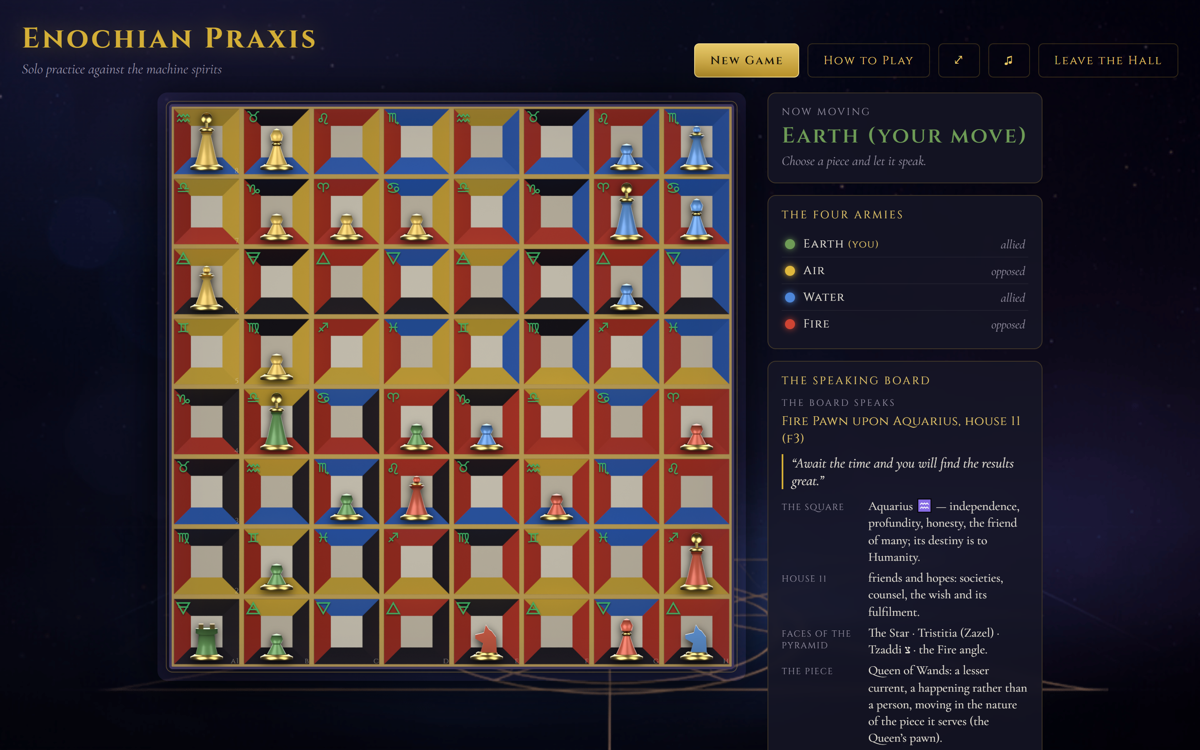
Every sign carries a mode and an element. The mode says how the sign acts, and the element says what it is made of. Taurus is fixed and earthy, which means it holds a position rather than starting or changing one. The Golden Dawn built its four boards on the four elements, and Earth is the ground of the receptive side. Earth takes the corner at a1, and its ally, Water, sits diagonally opposite at h8, never beside it. Those two armies are bound together as the passive, receptive alliance, set against the active pair of Air and Fire. Taurus does not command the Earth army the way a general would. It flavors the element the army is made of, and that flavor is stability.
If you want the full map of how all twelve signs hang on the board, start with the zodiac on the board, which lays out the whole system before you narrow to any one sign. To see how Earth behaves as a playing force, with its throne, its pieces, and its promotion edge, the guide to the Earth board is the natural companion to this page.
What steadiness looks like in play
Fixed Earth is not fast, and it does not need to be. The Earth army rewards a patient hand: build a position, hold your ground, and let the board come to you. This is the receptive posture in practice. Where the active alliance of Air and Fire tends to press and open lines, the Earth and Water side can afford to absorb pressure, keep its pieces coordinated, and wait for the moment when a solid structure pays off. That does not make Earth passive in the weak sense. A planted position is hard to dislodge, and an opponent who overextends against a rooted defense often hands you the game.
The receptive alliance also means Earth never fights alone. Its partner, Water, sits across the diagonal, and the two win and lose together. A Taurus-flavored patience suits that partnership well, because coordination between allies takes time to set up and pays off late. Two forces arriving together beat one force arriving early. If you are learning the pieces before you lean on any of this, the beginner's guide walks through the whole game at a gentle pace, and the piece that most tests a patient player is covered in the Enochian chess queen, whose two-square leap punishes anyone who rushes.
Rootedness and the receptive side
Rootedness is the word that best fits Taurus here. A rooted army does not chase. It occupies, and it makes the opponent pay to move it. On the receptive side that instinct is an advantage, because the whole strategy of Earth and Water is to be difficult to break rather than quick to strike. You are not trying to win in the opening. You are trying to still be standing, well organized, when the active side has spent its momentum. The Earth army embodies that better than any other, and Taurus, as fixed Earth, is the clearest expression of the mode.
None of this contradicts the actual rules of movement. The Earth King still steps one square, the Earth pieces still move as their kind moves, and the army still promotes toward its own far edge. What Taurus adds is not a mechanic but a temperament, a way of reading what the Earth force is for. It is the element that would rather endure than gamble, and that temperament threads through the receptive alliance as a whole.
How Taurus colors a reading
A finished Enochian game can be read as an oracle. Every square on the board carries divinatory attributions, and the way the armies ended up, who held the field, whose forces stood firm and whose scattered, becomes the substance of a reading. Taurus enters that reading through its element. When the Earth force ended a game strong, dominant, or well planted, the receptive and grounded qualities of fixed Earth are part of what the position is saying: hold what you have, build slowly, do not force the outcome. When the Earth army was broken or driven off, the reading may point the other way, toward stagnation, stubbornness, or a refusal to move that cost you.
This is a system-level reading, not a claim about any one square. The board does not tell you that Taurus governs a particular pyramid; it tells you how the Earth element fared, and Taurus is one of the three earthy voices in that chorus. To see how a whole game is turned into an oracle, the worked example on the divination page shows the method end to end, and Enochian chess and tarot traces the parallel layer of court cards and trumps that sits alongside the zodiac.
Feel the ground under the Earth army
Take the receptive side yourself and learn what a rooted position can do. Start a free game, play the Earth force patiently, and read what the board says when the dust settles.
Play NowKeep reading
Taurus is one voice in the earthy triad, and the board holds all twelve signs at once. Follow the sign back to its element in the four elements of Enochian chess, or step to the neighboring page on Aries to feel how a cardinal fire sign colors the active alliance instead.