The Air army in Enochian chess carries five god-forms: King Socharis, Knight Seb, Queen Knousou Pekht, Bishop Shu Zoan, and Rook Tharpeshest. These are attributions, one divine name laid over each of the army's five commanding pieces, not extra rules of play. An Air Bishop slides the diagonals the same whether you call it the Bishop or Shu Zoan. What the names do is give the corner a character, telling the player which powers the order read into the element of Air. The published Golden Dawn papers set these five over the Air pieces, and that authority is the whole of what stands behind them. This page names them, says the little that can be said plainly, and is honest about how obscure the rest are.
Every corner of the board carries a set like this. Each of the four elemental armies takes five god-forms, one for the King and one for each of the four majors, drawn from the same Egyptian pantheon the order worked with across its teaching. If you want the full grid of all four armies side by side, the Egyptian god-forms of the pieces lays them out together. This article stays with Air.
Where the Air army sits
Air takes the corner at a8 and belongs to the active side of the board, allied with Fire. Its partner sits across the long diagonal at the opposite corner, never beside it, so the two active armies press the board from far apart and answer for each other without ever capturing each other. Air's pawns march toward rank 1, which is the army's promotion edge. In the tarot court the order laid over the pieces, Air is the suit of Swords, so every piece here reads as a Sword court card as well as a god-form. The geography under all of this has its own page in the Air board, and the five names below sit on top of that ground.
King Socharis, the throned Air
The King of Air is Socharis, a rendering of the funerary god more usually written Sokar, a hawk-form power tied to the underworld and to the passage of the dead. That is the plain fact of the figure, and this article will not build more onto it than the papers support. As a piece the King moves one square in any direction, like every Enochian King, and he begins doubled on his throne with a major-piece partner set by the chosen opening array. Two units share his corner square at the start of the game. When you read the general account of the King in Enochian chess, Socharis is the Air face of that piece, the still center the whole corner is built to guard.
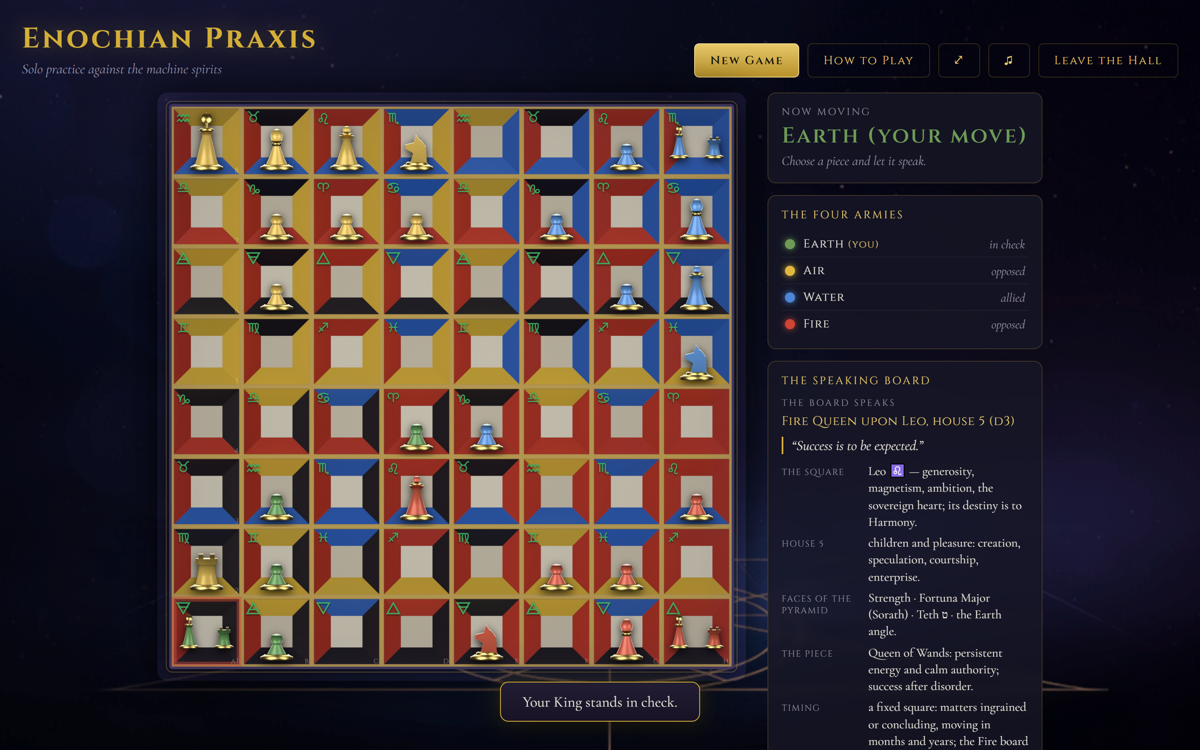
Knight Seb, the earth beneath the sky
The Knight of Air is Seb, a spelling the papers use for the god now more often written Geb, the earth-god of the Egyptian pantheon and, in the old family of the gods, the father of the sky. It is one of the few names in this army with a clear match in modern reference, though the order's spelling stays its own. On the board Seb is the leaping piece, the one that makes the ordinary chess knight's L-jump over whatever stands in the way, a move no other Air piece imitates and no blocker can stop. That reach sets the Knight apart from the sliders around it, which is drawn out against its cousins in the guide to the knight, bishop, and rook.
Queen Knousou Pekht, the leaping goddess
The Queen of Air is Knousou Pekht, and here the ground turns soft. This is a compound rendering of exactly the kind the papers are full of, joining forms the order carried over from the Egyptology of its day, and it does not line up with any single figure a museum label would name today. The honest course is to take it as an obscure attribution, a working name in a symbolic system, and not to invent a story to fill the gap. What can be said with certainty is how she moves, because the Enochian Queen is unlike any chess queen you know. She leaps exactly two squares in any of the eight directions, jumping clean over whatever sits between, and she cannot move a single square at all. She is a short-range leaper, never blocked, and the leap keeps her on one color for the whole game. The Enochian chess Queen page is worth reading before you trust her, because the two-square jump catches everyone out at first.
Bishop Shu Zoan, the diagonal power
The Bishop of Air is Shu Zoan, a name that opens on the familiar and then goes obscure. Shu is a known Egyptian god, the deity of air and of the space between earth and sky, which makes him an apt rider for this element. The second part, Zoan, is one of the order's own additions, and the pairing as a whole is a private compound rather than a standard title, so it is best marked as such. As a piece the Air Bishop is an ordinary diagonal slider, running any distance along the diagonals until an occupant halts it, and like every Bishop it is bound to one color for the whole game. A frozen piece still blocks its line, which matters more here than in ordinary chess, because in Enochian chess whole armies can freeze into inert terrain when a King is taken.
Rook Tharpeshest, the guarding form
The Rook of Air is Tharpeshest, and it belongs to the most obscure family of names in the army. It is presented here exactly as the papers render it, without invented backstory, because the sources do not give one and it would be dishonest to supply it. On the board the Air Rook is the familiar orthogonal slider, running along ranks and files until a piece or an edge stops it, blocked the same way the Bishop is, frozen pieces included. In the Golden Dawn court mapping the Rook stands as the Princess of its suit, here the Princess of Swords. Its pawn belongs to it and normally promotes back into a Rook when it reaches rank 1, though the game's delayed-promotion rule can leave a pawn waiting on the edge until the army has first lost one of its own.
Reading the five as a group
The Air army leans further toward the obscure than its allies do. Seb and Shu are broadly known, and Socharis is recognizable once you read past the spelling, but Knousou Pekht and Tharpeshest are compound renderings the papers set down with little explanation. That mix is normal for this game. The order worked from the Egyptology available in the late nineteenth century and shaped the names to its own ends, so the spellings do not always match what you would read now. Scholarly accuracy was never the point. The god-forms were meant to keep the living symbolism of Air in front of the player, so that moving the Queen felt like moving a power and not just a token. The names also sit inside a larger stack, since every Air piece reads at once as a rank, a Sword court card, and a god-form, and every square underneath carries attributions of its own. That stacking is what lets a finished game be read as an oracle, and the site's divination pages work the reading through in full.
A caution worth keeping, the same one that belongs on every army: these names are attributions from a specific Victorian magical order, not a clean lesson in Egyptian religion. Take them as the Golden Dawn meant them, as symbolic dress for the five Air pieces, and let the plain fact of the assignment stand without embroidery.
Move the Air gods yourself
Take the Air corner in a free game against the computer, no account and no download, and let Socharis, Seb, and Knousou Pekht stop being names on a page. The forms mean more once the pieces are in your hands.
Play NowKeep reading
The god-forms are one layer of a deep board. See the whole cast across the four armies, walk the geography of the Air board, or step back to how the whole set of pieces is put together.