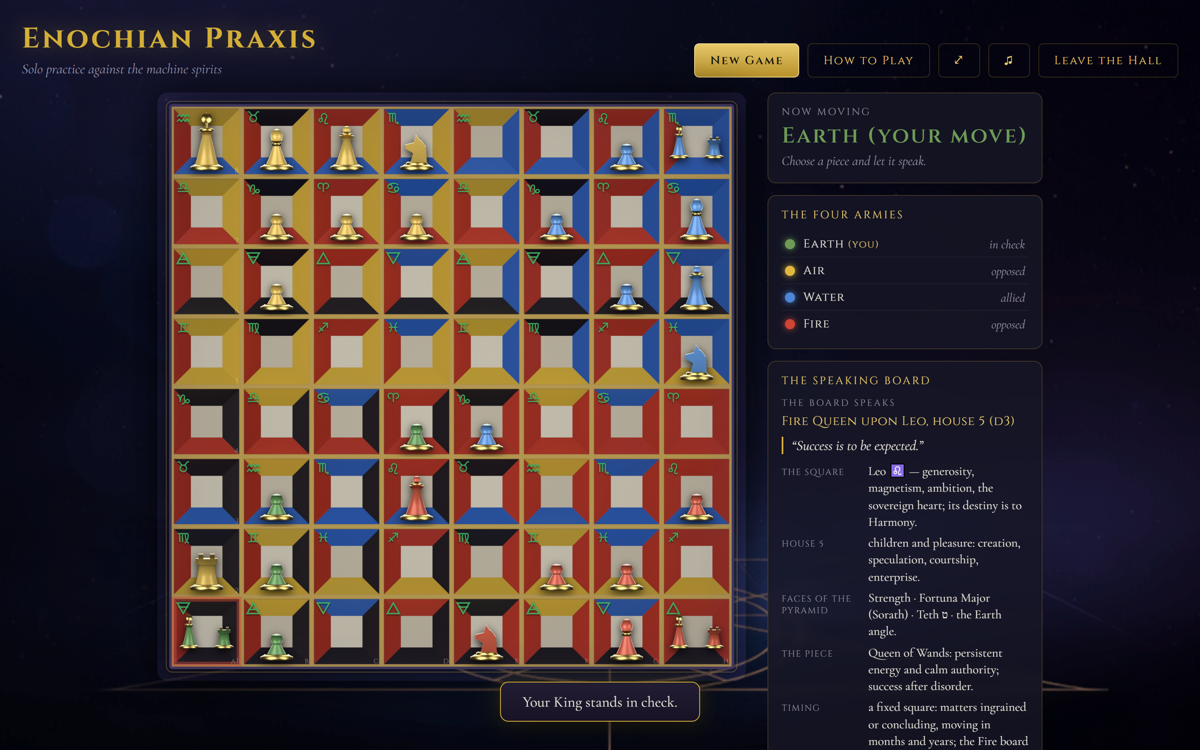
Four armies sit at the four corners of the board: Earth at a1, Air at a8, Water at h8, Fire at h1. They fight as two fixed alliances, Earth with Water and Air with Fire, and the pairing is never left to chance or seating. Your ally is always the army diagonally opposite you, at the far corner across the long diagonal, and never the army beside you. This is one of the first rules a new player meets, and it turns out to be one of the most consequential.
Opposite, not adjacent
Because allies sit at opposite corners, the two armies of a single alliance start as far apart as any two armies on the board can be. There is no cozy pair holding one edge together. Instead each alliance stretches across the whole field, and its two halves must fight toward one another through the middle, where the enemy armies sit on the other diagonal between them. The receptive alliance, Earth and Water, occupies one diagonal; the active alliance, Air and Fire, occupies the other. The board is split into two crossing partnerships from the first move.
Allies do not touch each other
Two rules protect the bond. Allies never capture each other, and allies never give check to each other. Your partner's pieces are friendly terrain you can move around and past without danger, and your King is never threatened by a piece of your own side. The alliance also shares a single fate: it wins and loses together. There is no personal survival inside a partnership, only the survival of the two-army side. That shared fate is what gives the next two mechanics their meaning.
The rescue only a diagonal ally can give
When a King stands in check and looks lost, his own ally may capture him rather than let an enemy take him. A King taken by his ally is not destroyed; he is held in trust, and his army does not freeze. It fights on under the ally's command. This rescue exists only because the two armies are partners, and the partner is the one across the diagonal. Read the full mechanic in the rescue capture.
The throne march that wakes the dead
The diagonal also sets the destination for the game's most dramatic move. A living King can march across the board to his ally's throne, the far corner, and take command of that army. If the ally's army had been frozen by an earlier King capture, reaching the throne reactivates it, and a force that had turned to terrain rises and fights again. The target of that long walk is always the opposite corner, because that is where the ally sits. The mechanic is laid out in throne seizure, and what freezing means is covered in frozen armies.
One placement, a whole personality
Seat the allies next to each other and Enochian chess would be a different, tamer game: two armies guarding one corner, easy to coordinate and hard to split. Seat them across the diagonal, as the rules do, and the alliance becomes a thing stretched across the board, vulnerable in the middle, capable of rescue and resurrection at its far ends. The diagonal alliance is not a detail. It is the reason a partner can save a doomed King and the reason a dead army can wake up.
See the diagonal in play
Open a free game and watch how your ally, across the board, opens paths you cannot reach alone. The whole shape of the fight follows from that one placement.
Play NowKeep reading
From here, follow the alliance into its two signature moves: the rescue capture and throne seizure, or step back to the four elements that decide who partners whom.