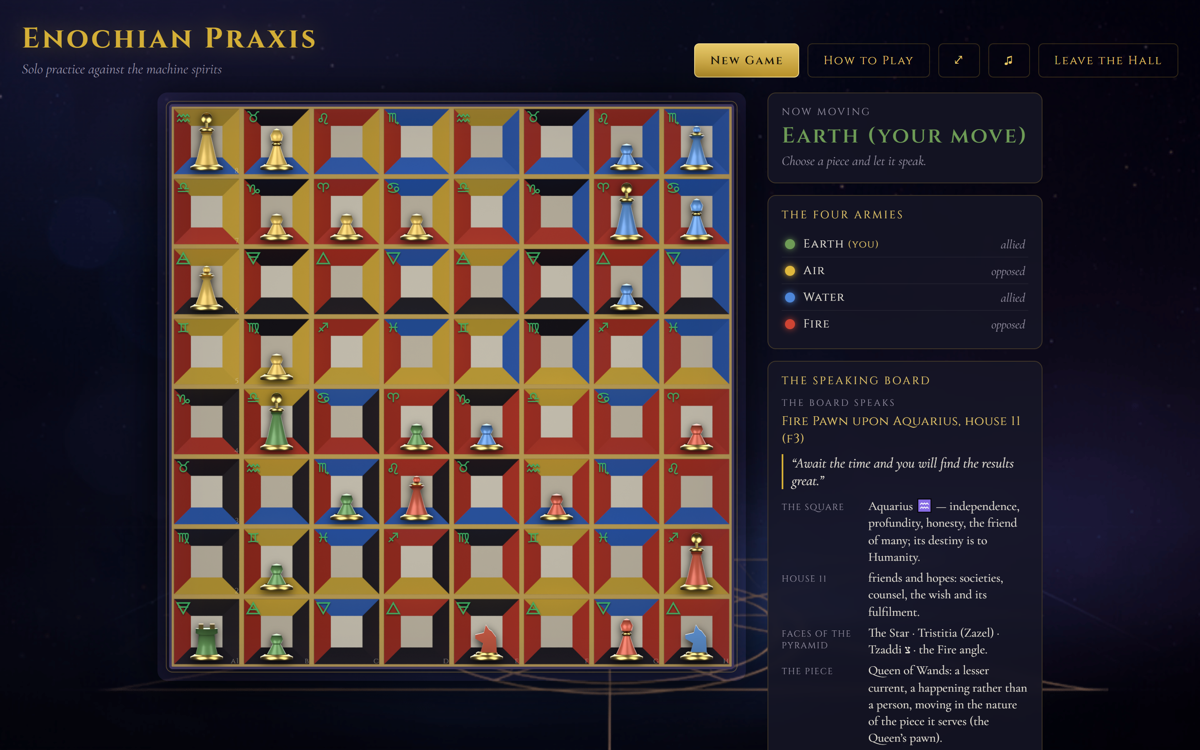
Enochian chess is built for four thrones. Earth sits at a1, Air at a8, Water at h8, and Fire at h1, one army to each corner of a single eight-by-eight board. Those four armies are locked into two alliances that never change: Earth and Water form the receptive side, Air and Fire the active one. Your ally is always the army at the corner diagonally opposite you, never the one beside you. That structure is what makes the game playable by two, three, or four people without altering a single rule. The seats simply get handed out differently.
Four players: one army each
The fullest form gives every player a single corner. You command one army, your ally sits diagonally across from you, and the two players between you are your opponents. Play rotates around the board in turn order, so you act, then the army to your side acts, and so on around the square. Because allies never capture or check each other and win and lose together, four-player Enochian chess is really two partnerships fighting across a shared field rather than a free-for-all. Everything you do is read by three other minds, one of whom is trying to help you and two of whom are not.
Two players: a whole alliance each
With two people, each player takes an entire alliance, both of its armies at once. One player runs Earth and Water from their two diagonally opposite corners; the other runs Air and Fire from theirs. You still move one army at a time as the turn order comes around to it, so a two-player game asks you to think from two corners of the board at once and coordinate your own pair the way allied players would coordinate with each other. It is the closest Enochian chess comes to ordinary two-sided chess, except that your "side" is split across opposite corners and must march to meet in the middle.
Three players: one hand holds a doubled alliance
Three players is the in-between case, and it is handled cleanly. One player takes a whole alliance, both of its armies, exactly as in the two-player game. The other two players each take a single army from the opposing alliance. So one side is run by one person commanding a diagonally opposite pair, and the other side is run by two people, one army apiece. The doubled player has more to track but also more reach across the board; the two single players have a lighter load but must coordinate as allies do. Which alliance gets doubled is chosen when the game is set up.
Empty thrones and the computer
None of these counts require a full table. On the free site you can play solo against the computer at Novice, Adept, or Magus strength, with the machine running all three other armies, and your game autosaves. Online, you can open a game for two, three, or four and let empty seats be run by the computer until living players claim them. That means a two-player idea and a four-player idea are not different games to learn; they are the same rules with the seats filled differently. For the full walk-through of setting up a table, see how to play, and for how partners think together, read playing as a team.
Why the alliances never bend
Whatever the count, the two alliances are the spine of the game. They are why a King in danger can sometimes be rescued by his own side, why a living King can march to his ally's throne and wake a frozen army, and why victory is always measured against a partnership rather than a single opponent. An alliance wins the instant both enemy Kings have been taken. Understanding that the four armies are really two teams is the single fact that makes every player count feel like the same game.
Start with any number of thrones
You do not need a full table to learn. Open a free game, let the computer hold the empty seats, and watch how the two alliances shape every move.
Play NowKeep reading
To go deeper, meet the four elemental armies in the four elements, learn how a turn passes around the board in turn order, or set a board yourself with how to set up Enochian chess.