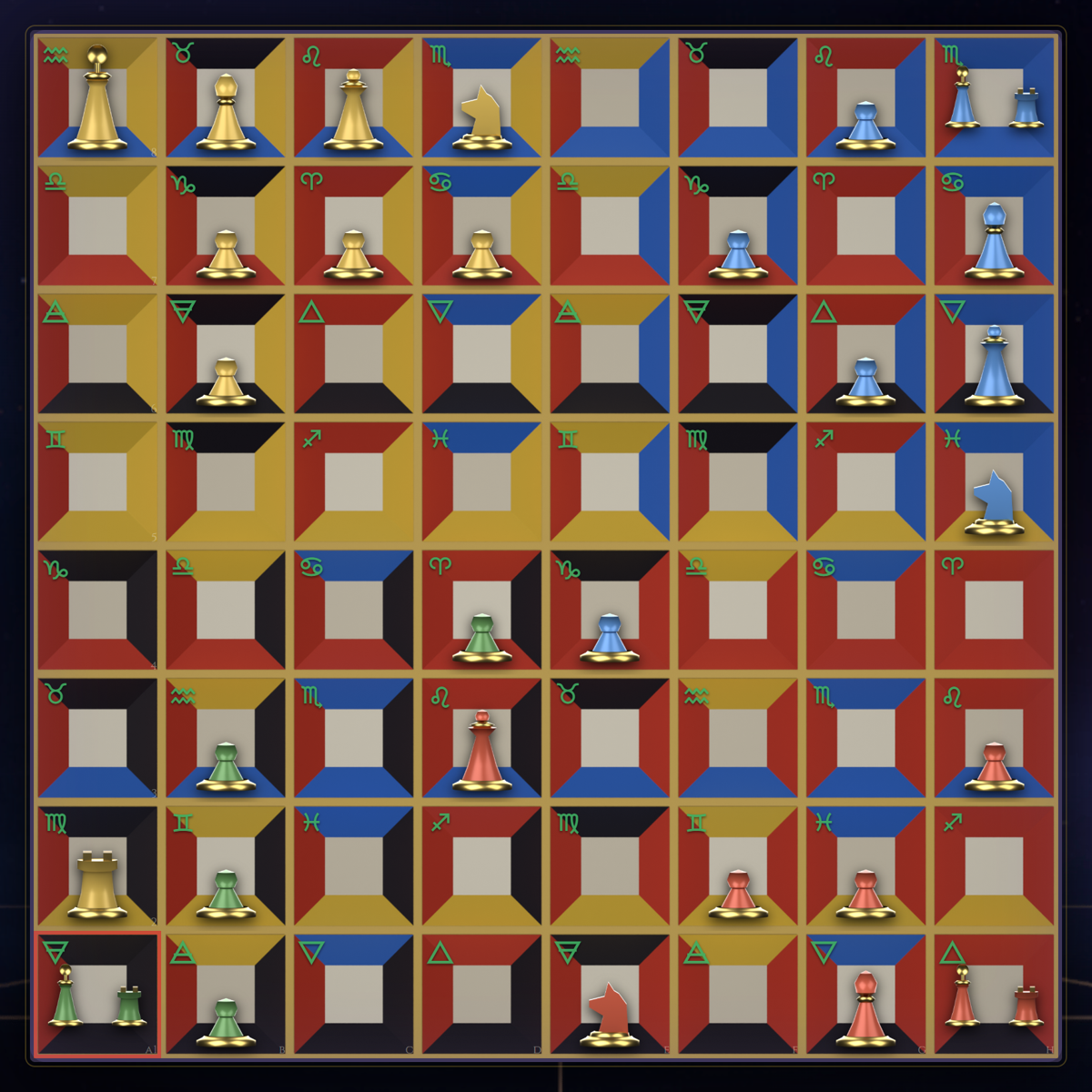
The Enochian Queen leaps exactly two squares in any of the eight directions, orthogonal or diagonal, jumping over whatever stands between. She cannot move one square, ever. Now count the colors. A two-square move along a rank, a file, or a diagonal always lands on the same color it started from. Do that for eighty moves and the Queen has still never stood on the other color. Half the board is closed to her from the moment the pieces are set out. The Bishop, an ordinary diagonal slider, is bound in the same way for the reason it always is in chess.
What the binding takes away
Start with the plain cost. A piece your Queen cannot reach is a piece she cannot threaten, no matter how many moves you give her. An enemy King parked on the wrong color is, as far as she is concerned, in another country. A pawn creeping toward its promotion edge on the wrong color cannot be stopped by her. This changes what it means to defend a square: your Queen guards half the squares around your King and is deaf to the other half. Your Bishop has the same deafness, on whichever color it happens to sit.
It also means two of your four major pieces cannot cover for each other in the way you might expect. If your Queen and your Bishop begin on the same color, the army has real strength on that color and a thin, obvious weakness on the other. If they begin on opposite colors, the two pieces divide the board between them and neither can reinforce the other's ground. Which of those you get depends on the setting you are playing, since the setting fixes the order of the majors and which one shares the King's throne. That is worth checking before you plan an attack: see the settings.
What the binding gives back
Now the other side of it. A color-bound piece is a piece whose whole future you can read at a glance, including your opponent's. If an enemy Queen sits on dark, every one of your pieces standing on light is permanently safe from her. That is not a temporary safety you have to keep re-checking each turn. It holds for the rest of the game. Good Enochian players use this constantly: they walk a King along the color the enemy Queen cannot touch, and they park vulnerable pieces where the strongest leaper on the board is structurally unable to reach.
The Queen's leap has a second property that makes her binding less painful than it sounds. She jumps. Nothing blocks her, not your own pieces, not enemy pieces, and not the frozen pieces of a captured army, which stop sliders dead but are simply flown over. On a crowded or half-frozen board the Queen is often the only piece still moving freely, and she does it on her own color. Her range is short and her color is fixed, but within those limits she is very hard to shut out. There is more on using her in tactics of the leaping queen.
The pieces that are not bound
It helps to name the pieces that ignore all of this. The Rook slides orthogonally and changes color with every step it takes, so it can reach every square on the board given time and a clear line. The Knight jumps its ordinary chess L and alternates color on every single move, which makes it the natural answer to a color-bound attacker. The King walks one square in any direction and so can also go anywhere. And the pawns march straight forward, one square at a time, capturing one square diagonally forward, which means a pawn keeps its color until it captures and switches it every time it does. That last detail matters more here than in ordinary chess, because a pawn's promotion is tied to the piece it belongs to. Read the pawns for how that works.
Practical habits
Three habits follow from the binding. First, note at setup which color your Queen and your Bishop live on, and treat the other color as ground you will have to hold with Rook, Knight, King, and pawns. Second, when an enemy threat appears, check its color before you panic. A great many threats in Enochian chess are structurally impossible, and beginners spend moves defending against them. Third, when you are choosing which piece to trade, remember that trading away your only major piece on a color hands your opponent a permanent free zone. The full movement reference is in how the pieces move, and the Queen's own page is the Queen.
A closing thought on the concourse
The color rule sits quietly underneath one of the game's strangest mechanics. Five two-by-two blocks are marked on the board, the central one and four near the corners, and if all four Queens come to stand alone on the four squares of a single block, the arriving Queen captures both enemy Queens and takes the allied Queen under her guidance. A two-by-two block holds two squares of each color, so the four Queens meeting there are split two and two by color, and the meeting can only ever be completed by a Queen leaping in from outside. Because she cannot move one square, she can never shuffle into place. She arrives, or nothing happens. See the concourse rule for the whole mechanic.
Watch the colors for one game
Pick a Queen at the start of a free game and follow her. She will never once stand on the other color, and half your planning gets easier the moment you notice.
Play NowKeep reading
Go deeper with tactics of the leaping queen, meet the diagonal slider in the Bishop, or get the whole movement reference in how the pieces move.