The Enochian chess Bishop is an ordinary diagonal slider. It moves any number of empty squares along a diagonal, in any of the four diagonal directions, and it captures the first enemy piece it reaches. There is no trick to the move itself. What changes is everything around it: the Bishop shares the board with three other armies instead of one, it can be stopped by pieces that have gone still, and it is welded to a single color of square from the first move to the last. Learn those three facts and you know the piece.
How the Bishop moves
Think of the chess Bishop and you already have the motion. It travels the diagonals, as far as the line is clear, and takes whatever enemy unit stands in its path. It cannot jump. Any occupied square ends the slide, so a single pawn parked on a diagonal can wall off a whole quarter of the board from your Bishop. This puts the Bishop at the opposite pole from the Enochian Queen, who leaps exactly two squares and vaults over anything between. Where the Queen ignores traffic, the Bishop is entirely at its mercy. If you have played standard chess, this is the piece that will feel most like home, which is worth remembering when you sit down at a board that otherwise works nothing like it. For the wider picture of how each unit travels, see how the pieces move.
Blocked by anything, including the frozen
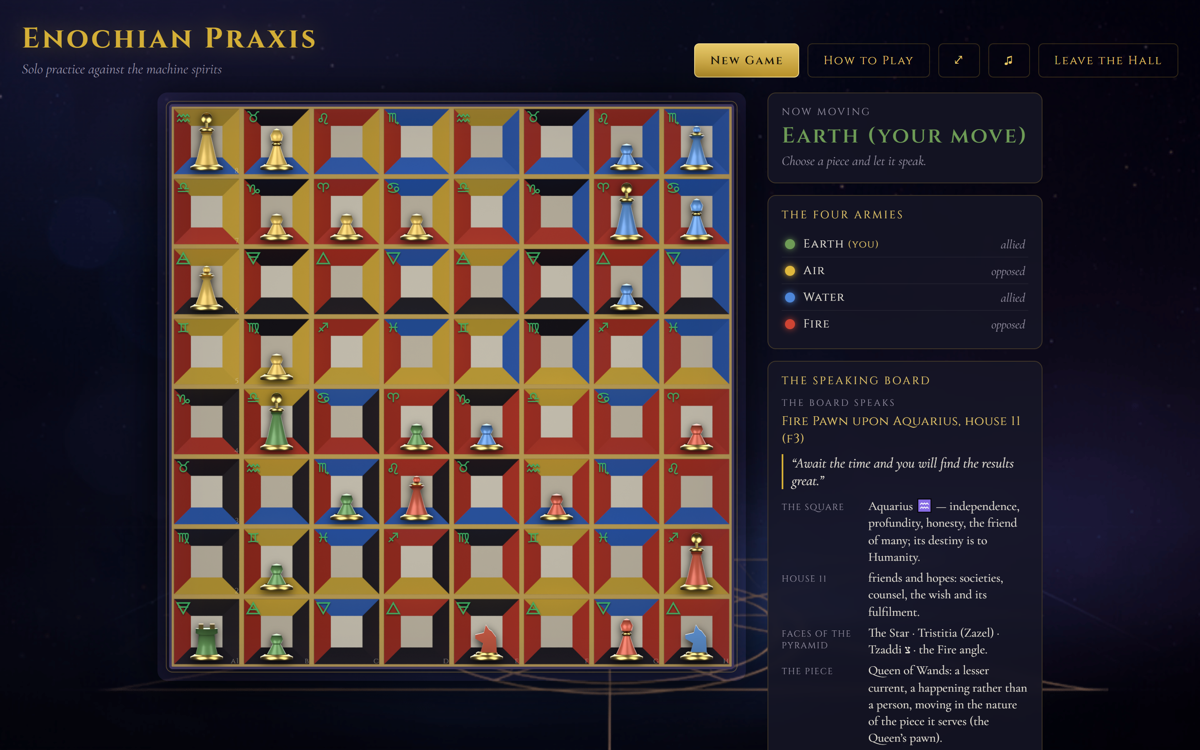
On a four-army board the diagonals are crowded, and the Bishop feels that crowding more than any other piece. Every one of the thirty-six units on a full board can stand in its way. So can something a two-player game never produces: frozen pieces. When an enemy captures a King, that whole army freezes in place and becomes inert terrain. Frozen units cannot move and cannot be captured, but they still sit on their squares and still block sliding lines. Your Bishop treats a frozen pawn exactly as it treats a live one. The diagonal simply stops there, and there is nothing you can do to clear it, because the frozen piece is beyond capture. A lane that was open at the start of the game can be sealed for good by an army that has stopped playing. If you want the full mechanics of how and why armies freeze, read frozen armies.
Color-bound for the whole game
A Bishop that begins on a light square will only ever stand on light squares, and one that begins on a dark square will only ever touch dark. This is the same lock a chess Bishop lives under, and it comes from the geometry of the diagonal: every diagonal step keeps you on the same color. Half the board is closed to each Bishop forever. It shares that trait with the Queen, whose two-square leaps also keep her on one color for the entire game, though the two pieces reach their color in completely different ways. The practical upshot is that a Bishop can never answer a threat sitting on the wrong color, and it can never defend a square of the wrong color. When you plan with a Bishop, plan for half the board only, and lean on your other pieces for the rest.
The Prince of the suit
Every Enochian piece carries a tarot court rank, and the Bishop is the Prince. The King is the Ace, the Queen keeps her own title, the Knight stays the Knight, and the Rook is the Princess. Suit follows the element of the army, so a Fire Bishop is the Prince of Wands, a Water Bishop the Prince of Cups, an Air Bishop the Prince of Swords, and an Earth Bishop the Prince of Pentacles. This is not decoration you can ignore. The pieces carry these attributions because a finished game is meant to be read, and the rank a piece holds shapes what its position says at the end. The court structure of the whole set is laid out on the pieces page, and the way a final board is interpreted lives in the divination guide.
The concourse of the Bishops
There is one rule that belongs to the Bishop alone, and it turns four ordinary pieces into a single event. Five two-by-two blocks on the board are marked: the four squares at the center, and one block set in near each corner. If all four Bishops, one from each army and none of them frozen, come to stand alone on the four squares of a single marked block, the Bishop that arrives last captures both enemy Bishops in one stroke and takes the allied Bishop under its command. The same rule exists for the four Queens. It is a rare and deliberate meeting, engineered rather than stumbled into, and when it lands it can swing a game. This is part of a larger pattern in Enochian chess where the forces gather and settle, which the papers call the concourse. You can read how the concourse works as a whole in the concourse of the forces and the specific move in the concourse rule.
Four god-forms, one for each element
The published Golden Dawn papers gave every piece an Egyptian god-form, and the four Bishops each carry their own. On the Earth army the Bishop is Aroueris. On the Air army it is Shu Zoan. On the Water army it is Hapimon. On the Fire army it is Toum. These were assigned to give the meditating player a figure to hold in mind as the piece moved, part of how the game worked as a study instrument and not only a contest. The god-forms run through the entire set, army by army, and they are gathered together in the Egyptian god-forms of the pieces.
Run the diagonals yourself
The Bishop is quickest to understand by moving it: watch how a single frozen pawn seals a lane, and how the color-lock shapes every plan. Start a free game against the computer or a live opponent.
Play NowKeep reading
The Bishop makes most sense next to its neighbors on the board. See how it sits beside the other sliders and jumpers in the Knight, Bishop, and Rook, and how the whole four-army game differs from ordinary play in Enochian chess versus regular chess.