Bughouse is the noisy, fast, four-player cousin of ordinary chess, usually played as two boards side by side. Enochian chess is the four-cornered board of the Golden Dawn, slower and stranger. They look nothing alike across the table, yet they are trying to solve the same problem: how do you make chess a team game where a captured piece still matters? Their answers could hardly be more different.
How bughouse works
In bughouse, four players form two teams of two, and each team seats one player as White on one board and as Black on the other. The trick is that the two boards trade material. When you capture an enemy piece, you hand it to your partner, who may later drop it onto their own board as one of their pieces, much as in shogi. Speed and communication rule the game: you shout for the piece you need, your partner feeds it to you, and attacks are built from a shared reserve flowing between two boards. It is chess as a live supply line between allies.
How Enochian chess differs at the core
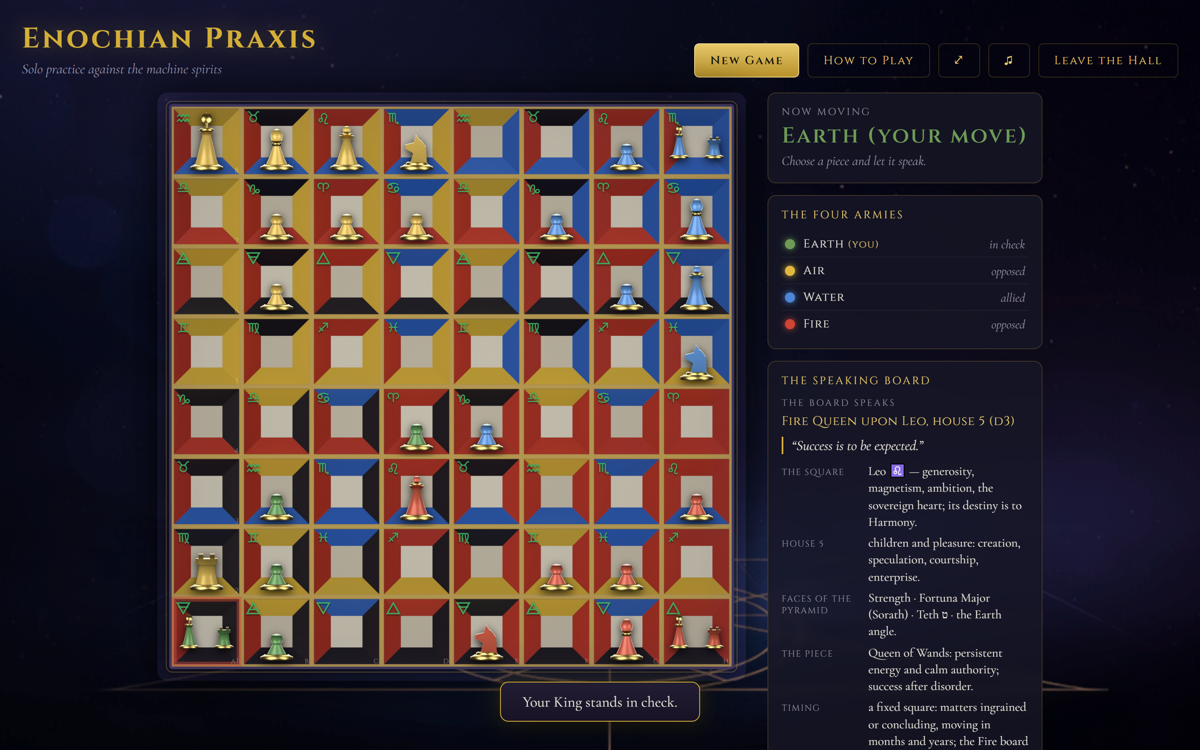
Enochian chess puts everything on one board. Four elemental armies sit at the four corners, paired into two alliances with each ally diagonally opposite, and they fight across a single shared field. There is no second board and nothing is passed between players. A captured piece is not handed to a partner to reuse. Instead the game's drama lives in what happens when a King falls: the whole army freezes into terrain, present but out of the fight, until it is either left as a monument or reawakened. The mechanic is described in frozen armies.
Two ideas of what a partner is for
In bughouse your partner is a supplier. Their captures become your ammunition, and the partnership is a flow of material across two boards. In Enochian chess your partner is a rescuer and a resurrector. Your ally can capture your endangered King to keep your army fighting rather than freezing, and your ally's throne is the destination a living King marches to in order to wake a frozen force. The alliance is not about passing pieces; it is about saving Kings and reviving armies. See the rescue capture and throne seizure.
How each game ends
The endings match the philosophies. Bughouse keeps ordinary checkmate: trap a King on either board and, subject to team rules, the game is decided, often in a blitz of dropped pieces. Enochian chess has no checkmate at all. Kings are captured outright, and an alliance wins only when both enemy Kings have been taken and the field is held, a slower verdict that a rescue or a reawakened army can postpone. Bughouse is a sprint of shared ammunition; Enochian chess is a siege of frozen and revived forces. For the wider family of team and four-handed games, see four-player chess variants, and for another drop game set beside Enochian chess, read Enochian chess versus shogi.
Try the one-board team game
If bughouse is a supply line, Enochian chess is a siege. Start a free game, take a King, and watch a whole army freeze on the board it never leaves.
Play NowKeep reading
Compare more games in Enochian chess versus shogi and four-player chess variants, or learn what makes a fallen army freeze in frozen armies.