If you ask who gave Enochian chess its shape, the answer that the published Golden Dawn papers support is Samuel Liddell MacGregor Mathers. He was a leading figure of the order and the person most tied to its teaching material, the instructional papers that members studied as they advanced. The chess belongs to that body of teaching. The four elemental boards, the god-forms placed on the pieces, and the odd rules that separate this game from ordinary chess all reach us through those papers, and Mathers is the name that stands behind them. What follows keeps to what the papers actually carry, because the rest is guesswork.
Who Mathers was, in short
Mathers was one of the founders and driving minds of the Hermetic Order of the Golden Dawn, the late nineteenth-century magical society that produced this game. His role in the order was largely one of building its curriculum: he wrote and arranged the graded instructional papers that members worked through, drawing on Kabbalah, tarot, astrology, and the Enochian system. That curriculum is where the chess lives. So when the game is credited to him, the credit is really about authorship of teaching material, not a claim that he invented four-handed chess out of nothing. The four-cornered form has older cousins, as our piece on Enochian chess and other four-player games lays out. What Mathers and the order did was bend that shape to their own symbolic ends.
Why the game takes the form it does
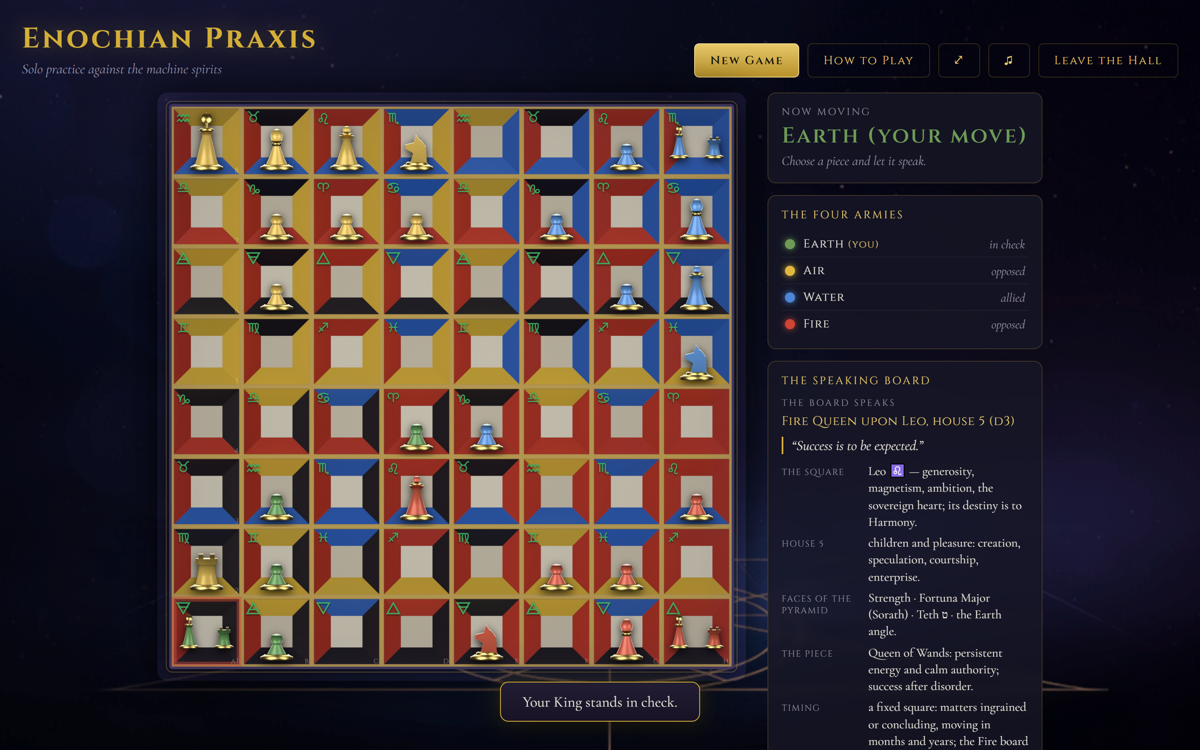
The reason Enochian chess looks the way it does is that the Golden Dawn needed a chessboard that could speak its symbolism. The order worked with four elements, so the game has four armies at the corners: Earth, Air, Water, and Fire. The order worked with the Enochian tablets that John Dee and Edward Kelley recorded in the 1580s, so the game has four boards built on those tablets, one per element. You can read more on that lineage in our note on John Dee and the chessboard. The elements pair into two fixed alliances, Air with Fire and Water with Earth, and each ally sits at the corner diagonally opposite, never beside its partner. None of this is decoration bolted on afterward. The structure is the point, and it is why the game reads as more than a pastime.
What the papers actually claim
It helps to separate what the published papers support from what people sometimes add. The papers give the setup, the moves, and the systems that make the game strange: kings captured outright with no checkmate, an army frozen into inert terrain when its king falls, the queen who leaps exactly two squares and never one. They give the god-forms too, the Egyptian names attached to each rank of pieces so a board becomes a small pantheon. Those are attributions carried in the material, and you can meet them in our piece on the Egyptian god-forms of the pieces. What the papers do not give is a tidy biography of the game's making: no dated invention scene, no signed patent. Careful writing about the history stops where the sources stop. If you want to see one of those strange rules up close, the queen is the clearest case. She leaps exactly two squares in any direction and jumps whatever sits between, and she cannot move a single square. Our page on the Enochian chess queen walks through why that one change reshapes the whole board.
A game meant to teach and to divine
Mathers built curriculum, and the chess fits that purpose exactly. It was never only a contest. Every square on the board carries divinatory attributions, a sign, a trump, a letter, a figure, a house, so a finished game can be read as an oracle. The pieces map onto the tarot courts. Playing well and reading the result were two halves of one practice for advanced members. That double life, part study drill and part divination tool, is the clearest fingerprint of the mind that assembled it, and it is why the game still rewards attention rather than just competition. If that side draws you, start with how to divine with Enochian chess.
How the game reached us
Here is the practical part. Most of what the public knows about Enochian chess did not come straight from Mathers or the order in his lifetime. It came later, when Israel Regardie published the Golden Dawn papers, putting the once-guarded material into print where anyone could study it. That is the chain: the order shaped the game, Mathers stands closest to the teaching material, and Regardie is the reason the rules survived to be played at all. When you see a claim about how Enochian chess works, the honest source to point at is the published papers, not any single figure's memoir. The rules on this site trace to that same body of material.
See the shape for yourself
Reading about the four-cornered design is one thing; watching the armies move is another. Open a free board, take a seat, and let the elemental structure make its own case.
Play NowKeep reading
To place Mathers in the larger picture, read about the Golden Dawn and its chess, and see how the elemental tablets behind the boards took shape in our note on the four watchtowers. The clearest way to feel what the teaching material built is still to sit down and play a game.