A sacrifice in Enochian chess trades material for time and position, the same bargain you would make in ordinary chess, but the account is settled across four armies instead of two. You are never just spending a piece to open a line. You are spending it to save an allied King, to win your partner a tempo they can spend on the far side of the board, or to change who moves next in a rotation that runs Earth, Air, Water, Fire and back again. Because turns pass around the board rather than back and forth, a tempo here is not one move ahead of one opponent. It is a shift in a four-beat cycle, and that makes it behave in ways a two-player player has to relearn.
What tempo means when four armies take turns
In two-player chess, tempo is simple: a wasted move gives your single opponent a free turn. On the Enochian board four armies move in a fixed rotation, and your ally sits at the corner diagonally opposite you, never beside you. That geometry means the sides alternate on every turn. Between your move and your next move, three other armies act: one of yours and two of the enemy's. A tempo you win does not land on your own next turn. It lands on whichever army moves next in the cycle, and often that army is your partner, not you.
So the real question is never only "do I gain a move." It is "who gains the move, and where does their next turn fall in the rotation." A gift of time to your ally, arriving one beat before the enemy can respond, can be worth far more than the same gift to yourself. If you have not yet mapped the turn cycle, the piece on turn order, deosil and widdershins lays out both rotations, and the broader strategy overview puts tempo alongside the other levers you have.
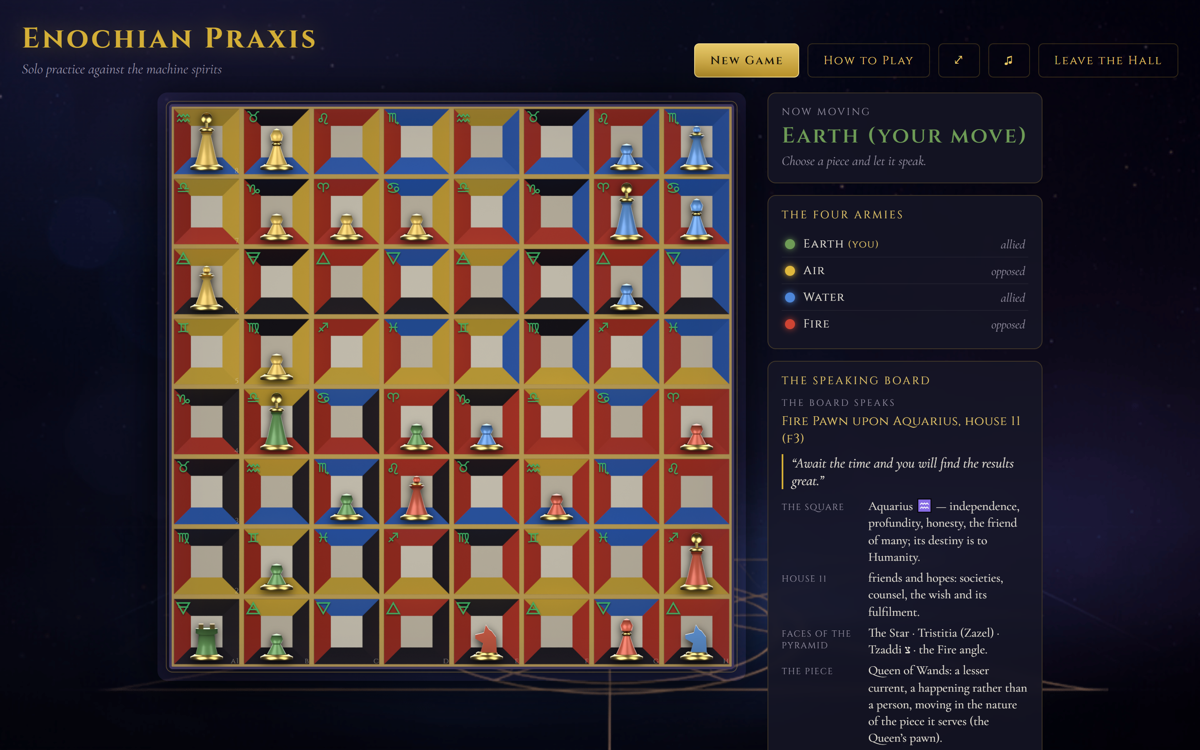
The sacrifice that buys a King
The signature reason to give up material here has no equivalent in ordinary chess. There is no checkmate in Enochian chess. Kings are captured outright like any other piece, and when an enemy takes a King, that whole army freezes into inert terrain: it cannot move, cannot be captured, and simply blocks lines. Losing a King is losing an army. So when your ally's King stands in check with no safe square, the stakes are an entire force going cold.
This is where a sacrifice earns its keep. You can spend a piece to interpose on the line, to remove the attacker, or to open an escape square, and the piece you give up is cheap against a whole army saved. There is a second, stranger option the papers describe: the rescue capture. When your ally's King is in check, you may capture him yourself. A King taken by his own ally is not lost. He is held in trust, his army keeps fighting under your command, and it never freezes. Sometimes the cleanest way to spend a tempo is to spend your own move seizing your partner's King before the enemy can. The mechanics of that move live in the rescue capture, and the fate of an army whose King does fall is covered in frozen armies.
Freeing your partner a tempo
Most sacrifices are quieter than a King rescue. The everyday version gives your ally a free turn to arrive. Because you run two coordinated attacks from opposite corners, the whole art of the team game is timing: getting both forces to bear on the same point on the same beat. A threat you cannot answer with one army can often be answered by the other reaching across the board, but only if it arrives in time. A sacrifice that removes a blocker, opens a diagonal, or forces an enemy reply can hand your partner the one tempo they needed to complete the pincer.
The trick is that the tempo has to fall on the right army. Give up a piece to force an enemy response, and the rotation keeps turning: the enemy spends a move answering, and by the time it comes back around, your ally may be the one who profits, arriving a beat ahead of the defense. Read the cycle before you spend, because a sacrifice that frees the wrong army at the wrong point in the rotation just donates a piece. Coordinating those arrivals is the heart of playing as a team, and the danger you are usually racing is covered in defending your King.
The Queen makes sacrifices sharp
Tempo math changes with the pieces on the board, and the Enochian Queen changes it more than any of them. She does not slide. She leaps exactly two squares in any of the eight directions, jumping over whatever stands between, and she cannot move a single square. That makes her a short-range shock piece, not a long-range guard. A leaping Queen can strike from behind a wall of pieces without needing a clear lane, so a sacrifice that opens the board for her often costs you nothing she needed anyway. She was going to jump the gap regardless.
The flip side is that she is a poor defender of the square right next to her, and she cannot retreat one step to safety. Giving up a piece to lure an enemy Queen onto a square where she cannot leap back is a genuine tempo trap. Learn how her jump works before you build tactics around it, in the Enochian chess Queen explained.
When not to sacrifice
The four-army structure punishes loose sacrifices harder than two-player chess does. Give up a piece that does not clearly buy a King, a tempo for your ally, or a position you can convert, and you have not just weakened yourself: you have handed the whole enemy alliance a material edge that both of their armies get to press. Your ally cannot move your pieces for you, and you cannot count on rescue from a partner who is busy on the far corner. Before you commit, ask whether the tempo you win lands on an army that can use it before the rotation swings back to the enemy. If the answer is no, hold the piece.
Try a sacrifice for yourself
The fastest way to feel how tempo moves around four armies is to play a game and give a piece up on purpose. Start free against the computer, or bring an ally online.
Play NowKeep reading
Sacrifice is one tool among several. See how a whole game is decided in how you win at Enochian chess, and how the King's danger drives the whole board in the King in Enochian chess.