Go is played on the intersections of a nineteen by nineteen grid with identical black and white stones. Players place a stone per turn, stones do not move once placed, groups are captured by having their last liberty taken, and the winner is whoever surrounds more territory. Enochian chess is played on an eight-by-eight board with four differentiated armies at the four corners, pieces that move rather than get placed, and a victory condition that turns on capturing Kings. Different games in almost every mechanical respect. What they share is a preoccupation with space and with what happens to the dead.
Placement against movement
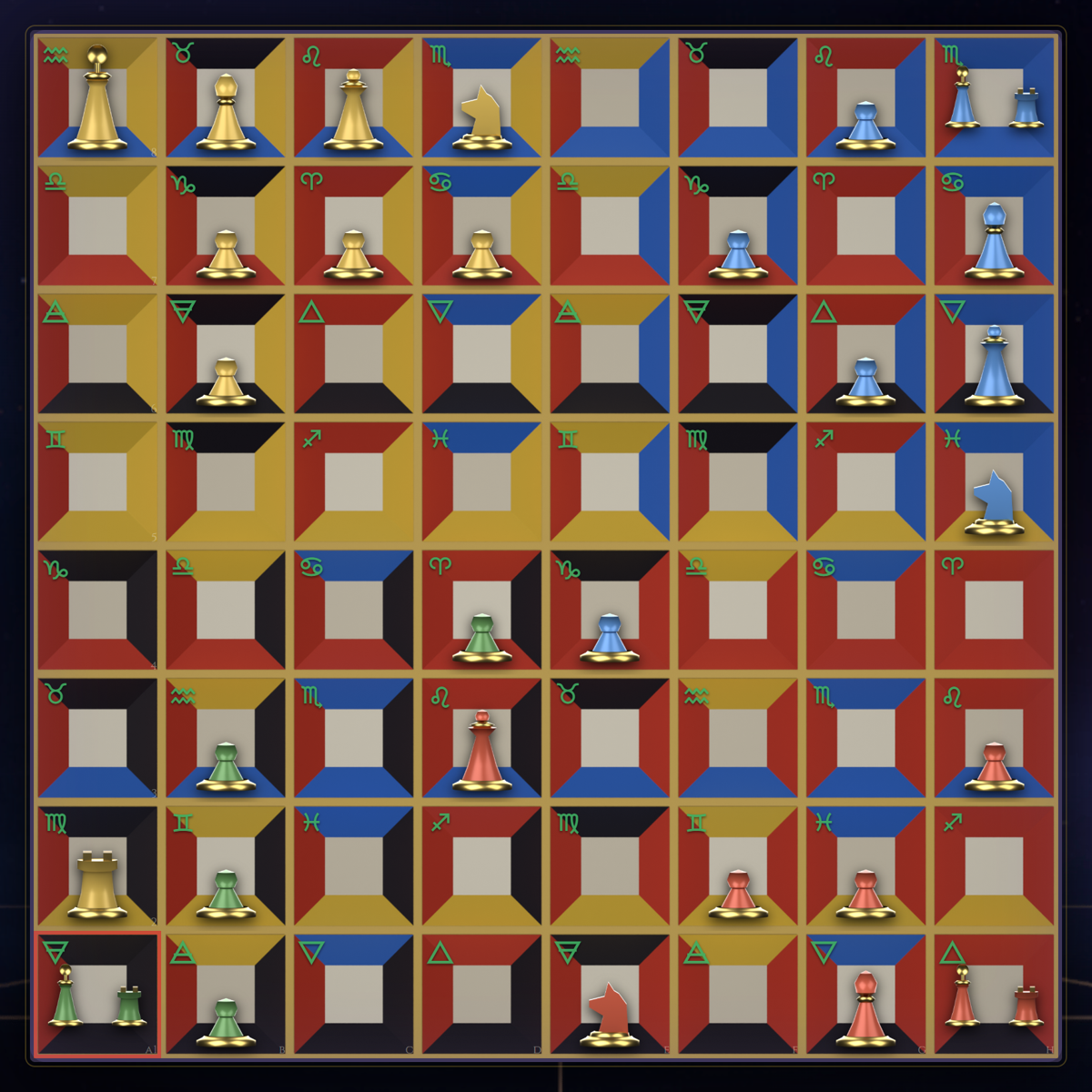
The first and largest difference is that Go stones are placed and Enochian pieces move. A Go player builds a position by addition, and a stone's job is mostly to exist in a good spot. An Enochian player has a fixed force from move one, nine units per army, and everything after that is about routing them: a Queen who leaps exactly two squares and jumps over anything between, a Knight on its L, a Rook and a Bishop sliding until something stops them, pawns walking one square at a time with no double step and no en passant. Go asks where the next stone should go. Enochian chess asks which of thirty-six standing units should be somewhere else. See how the pieces move.
Two answers to dead material
Here is where the games rhyme. Captured Go stones come off the board, and the empty space they leave is the point: territory is what you have surrounded. Captured Enochian Kings do something stranger. When an enemy takes a King, that King's entire army freezes in place as inert terrain. The pieces cannot move, cannot be captured, and threaten nothing, yet they still block every sliding line they sit on. Go clears space to claim it; Enochian chess fills space with material nobody can use. Both games end up being about a board whose geography has been rewritten by fighting, but one rewrites it by subtraction and the other by petrification. Read frozen armies and fighting around a frozen army.
There is a further twist Go has no equivalent for. A frozen army is not permanently dead. A living King who marches to his ally's throne takes command of that army, and arriving there reactivates it. Dead stones do not stand up in Go. In Enochian chess a whole frozen force can rejoin the game because one King walked to a corner. See throne seizure.
Two players against four
Go is a two-player game, and its clarity comes partly from that. Enochian chess seats four armies in two fixed alliances, Earth with Water and Air with Fire, each ally at the corner diagonally opposite rather than beside. Allies never capture or check each other and win and lose together, and the table can be shared by two, three, or four people without changing a rule. That produces a kind of position Go never has: one where your best move depends on what your partner across the board is about to be able to do. See the diagonal alliance and two, three, or four players.
Scoring against capture
Go ends by counting. Territory and captures are tallied and a margin decides it, so a Go game is a continuous quantity and most games are close. Enochian chess ends by event: an alliance wins the moment both enemy Kings have been taken and the field is held. There is no margin and nothing to count. A game can also be drawn outright, by the hundred-move rule, by four bare Kings, by an alliance reduced to two bare Kings, or by a board so locked that no army can move. See how you win and draws.
The layer Go does not have
The last difference is not mechanical. Go is a pure abstract, and its beauty is that nothing in it means anything outside the game. The Enochian board is the opposite: every square carries divinatory attributions, a sign of the zodiac, a tarot trump, a Hebrew letter, a geomantic figure, an astrological house, and each square is drawn as a small pyramid so its four faces can hold them. A finished game can be read as an oracle, which is what the Golden Dawn built it for. You can play it as a pure four-handed strategy game and many people do, but the symbolic layer is not decoration added later. It is the reason the game exists. See the divination guide, and for the wider family of variants, four-player chess variants.
Try the four-cornered board
If you like Go for the way a position becomes a landscape, Enochian chess does it with pieces that freeze where they fall. Play free, solo or online.
Play NowKeep reading
Compare more games in Enochian chess versus xiangqi and versus shogi, or read where the game came from in the Golden Dawn and Enochian chess.